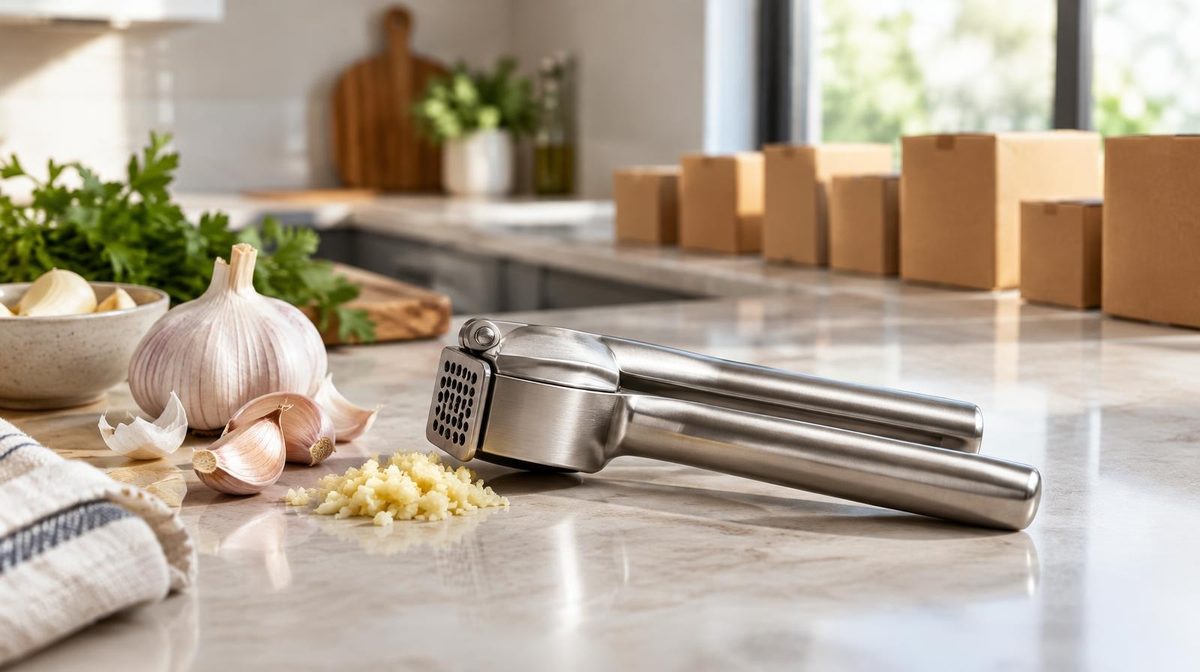
Marcus resells a well-known brand of kitchen tools. He found a garlic press with strong sales, nine other FBA sellers on the listing and a healthy price. He set up a Sponsored Products campaign with a $30 daily budget and waited.
A month later the campaign had spent $212. Not $900. The keywords looked fine, the bids looked fine, and the campaign showed as delivering. The answer sat in a different report: his Featured Offer percentage on that ASIN was 22%. His ads could only run during the 22% of the time he held the Buy Box. The other 78% of the time, they simply didn't exist.
That is the first thing to understand about Amazon PPC for wholesale: the rules are the same as for a private label brand, but the economics are not. You don't own the listing, you share it with competitors, and your margin is usually half of what a brand owner works with. This guide covers how reseller advertising actually works, the math that decides whether it pays, which targets make sense, and when the right answer is to not advertise at all.
How Amazon PPC Works When You Don't Own the Listing
A wholesale seller lists an offer on an existing detail page. The brand owner, or whoever created the listing, controls the title, images, bullets and A+ Content. You control your price, your fulfillment method and, if you choose, your advertising.
Amazon lets any Professional seller run Sponsored Products on an ASIN they sell. There is one condition that changes everything for resellers: a Sponsored Products ad only serves when your offer is the Featured Offer, the one in the Buy Box. Lose the Buy Box and your ad stops showing. Win it back and the ad becomes eligible again.
The other ad types are mostly closed to you:
| Ad type | Available to wholesale sellers? | Why |
|---|---|---|
| Sponsored Products | Yes | Any Professional seller, as long as you hold the Featured Offer |
| Sponsored Brands | No | Requires Brand Registry for the brand |
| Sponsored Display | No, for most sellers | Sellers need Brand Registry |
| Sponsored TV / DSP | Not practical | Built for brand owners with budgets far above typical reseller spend |
So wholesale PPC is Sponsored Products PPC. That's not a bad thing. Sponsored Products drives the bulk of ad sales for most sellers anyway. It just means every lever in this guide sits inside one ad type, and you can't fix a weak main image or title with better creative, because both belong to the brand.
The Buy Box Share Problem
On a private label listing you are the only seller, so you hold the Buy Box close to 100% of the time. On a wholesale listing, the Buy Box rotates between eligible offers based on price, fulfillment, seller metrics and stock. Your share of that rotation sets a hard ceiling on your ad exposure.
You can see your share in Seller Central under Business Reports → Detail Page Sales and Traffic by Child Item, in the Featured Offer (Buy Box) Percentage column. We walk through every column in our Amazon Business Reports guide.
A low share causes four problems at once:
- Impressions are capped. At 25% Buy Box share, your ads are eligible for roughly a quarter of the auctions a single-seller listing would enter.
- Data builds slowly. A keyword that would collect 30 clicks a week on a private label ASIN might collect 7. It takes four times longer to know whether it converts.
- Budgets don't spend. Like Marcus, you'll see campaigns that never hit their cap. Raising the budget does nothing, because the budget was never the constraint.
- Ads switch on and off with your repricer. Every time your price moves out of the winning range, delivery stops. Performance looks random until you overlay Buy Box share on it.
If a wholesale campaign has stalled with almost no impressions, check Buy Box share first. It's the first cause in our Amazon ads not getting impressions diagnosis for a reason.
The Free-Rider Problem
There's a second, less obvious issue. Ads drive sales, and sales improve the listing's organic rank. On a shared listing, that organic lift belongs to everyone on it.
Say you hold the Buy Box 30% of the time and your ads push the garlic press from position 14 to position 6 for "garlic press". The organic orders that follow get split by Buy Box rotation, so roughly 70% of them go to the other sellers. You paid for the climb. They collect most of the reward.
This is why the halo effect that makes PPC worth it for brand owners is much weaker for resellers. A brand owner can accept a high ACoS during launch because organic rank pays it back later. A wholesale seller usually can't count on that payback. Your ad spend has to pay for itself on attributed sales alone.
The Margin Problem: Break-Even ACoS for Wholesale
The second constraint is margin. Private label sellers often work with 30-40% margin before ads. Wholesale sellers buy at a distributor price and compete on price for the Buy Box, so 10-20% is more typical.
Here's a realistic wholesale ASIN:
| Line item | Amount |
|---|---|
| Sale price | $24.99 |
| Referral fee (15%) | -$3.75 |
| FBA fulfillment fee | -$5.40 |
| Cost of goods (wholesale price) | -$11.50 |
| Inbound shipping, prep, storage | -$0.60 |
| Profit before ads | $3.74 |
| Break-even ACoS | 15.0% |
Break-even ACoS is profit before ads divided by price: $3.74 / $24.99 = 15%. At 15% ACoS, every ad sale earns exactly zero. If you want to keep at least $1.50 per ad-driven unit, your target ACoS is ($3.74 - $1.50) / $24.99 = 9%.
Compare that to a private label product at the same price with $9.00 of pre-ad profit: break-even ACoS 36%, and room for a 25% target. The wholesale seller has less than half the room to work with. That's why benchmark numbers from articles about what a good ACoS is can mislead resellers. A 25% ACoS that looks healthy for a brand would lose money on almost every wholesale ASIN.
What That Means for Your Bids
Your maximum profitable cost per click comes from three numbers:
Max CPC = Price × Conversion rate × Target ACoS
Wholesale has one advantage here: established brands often convert well. Shoppers already know the product, and the listing usually has hundreds or thousands of reviews. At a 20% conversion rate:
- At the 9% target: $24.99 × 0.20 × 0.09 = $0.45 per click
- At break-even (15%): $24.99 × 0.20 × 0.15 = $0.75 per click
If the category's average CPC on your target keywords is $1.20, the math is over before you launch. No amount of optimization makes a $1.20 click profitable on this ASIN. If clicks run $0.40-0.60 on long-tail terms, there's a real opportunity.
Pro Tip: Calculate break-even ACoS at your repricer's minimum price, not the current price. If your repricer can drop to $22.49 to win the Buy Box, your profit before ads falls to about $1.62 and break-even ACoS to roughly 7%. Ads that are profitable at $24.99 lose money every time the repricer goes to the floor.
When Wholesale PPC Is Worth Running
Combine Buy Box share and margin and you get a fairly clear decision. These are the thresholds we use:
| Situation | Buy Box share | Pre-ad margin | What to do |
|---|---|---|---|
| Exclusive or near-exclusive distribution | 70%+ | 15%+ | Run full Sponsored Products, much like a private label ASIN |
| Shared listing, stable price | 40-70% | 15%+ | Selective: exact match long-tail and low-bid auto only |
| Crowded listing or price war | Under 40% | Any | Skip ads; compete on price, stock and fulfillment |
| Any share | Any | Under 10% | Skip ads; no bid survives the margin |
| Amazon Retail on the listing | Usually low | Any | Skip ads unless you reliably win the Buy Box |
Elena's case shows the top row. She's the exclusive US Amazon distributor for a small European cookware brand. Her Featured Offer share sits at 96%, the brand owner doesn't advertise in the US, and her pre-ad margin is 22%. She ran Sponsored Products with the brand's written approval and set a 12% ACoS target. Six months in, her ad ACoS averages 11% and her TACoS is 4%. For her, wholesale PPC behaves exactly like private label PPC, because in practice she owns the shelf.
Marcus is the third row. Nine sellers, 22% share, and a price that drops every time a new seller joins. The best use of his $30 a day was not advertising that garlic press at all. He moved the budget to two ASINs where he held more than 75% of the Buy Box.
💡 Daniks.AI Advantage: You can set a separate ACoS target per product, so a thin-margin wholesale ASIN runs at 9% while a higher-margin one runs at 20% in the same account. Bids adjust around the clock, which matters on shared listings where your ads switch on and off with the Buy Box. Try it free for 14 days.
Which Targets Make Sense for Wholesale
With Sponsored Products as your only tool and little margin to spare, targeting has to be tight.
Exact Match on Product-Specific Long-Tail Terms
Shoppers searching for "stainless steel garlic press with cleaner" are close to buying and often have the exact product in mind. These terms tend to be cheaper than broad head terms like "garlic press" and convert better. Start here, with exact match, at or below your target max CPC.
Auto Campaigns, Close Match Only, Low Bids
Auto campaigns still help you discover search terms, but on a thin margin you can't afford the loose-match and complements groups. Keep close match on, set the other groups low or off, and run a discovery budget you're willing to lose. Move converting search terms into exact match campaigns. Our Amazon ASIN targeting guide explains how to treat the product-targeting groups if you do test them.
Product Targeting on Competing Brands
You can target competitor ASINs with Sponsored Products just like a brand owner can. This works best when your product has a clear edge on the competitor's page: more reviews, a better rating, or a lower price. If the competitor is cheaper and better rated, shoppers won't switch, and you'll pay for clicks that bounce back.
Brand Name Keywords: Read Your Agreement First
Branded searches ("[brand] garlic press") convert very well, because the shopper already wants that brand. They are also where wholesale sellers get into trouble.
Dev learned this the expensive way. He bid on the brand name for a supplement line he bought through an authorized distributor. Within three weeks he got an email from the brand's channel manager: his reseller agreement prohibited using the brand's trademark in paid advertising, and the brand owner's own campaigns were now bidding against his. He lost his authorization and the supply that came with it.
Amazon doesn't block you from bidding on a brand name, but many distribution and authorized-reseller agreements do, along with MAP policies that limit how you can promote price. Read yours. If it's silent, ask the brand. Some brands welcome reseller ads on their listings; others treat them as competition for their own spend.
How to Set Bids and Budgets for Wholesale Listings
A few adjustments make Sponsored Products work on a shared listing:
- Set the target ACoS from your floor price. Use the lowest price your repricer can reach, not today's price.
- Start bids at max CPC, not above it. There's no organic payback to justify an aggressive launch.
- Keep budgets modest. With a low Buy Box share, a large budget won't spend anyway, and when the share suddenly jumps, a modest cap protects you from a burst of unprofitable clicks.
- Judge keywords on clicks, not days. A keyword with 8 clicks over three weeks hasn't proven anything. Wait for a real sample before cutting it, and add search terms that clearly don't fit as negatives early. Our negative keywords guide covers how.
- Watch Buy Box share next to ad metrics. If ad sales fall while bids and budgets are unchanged, the Buy Box is the first thing to check.
- Keep your repricer and your ads in the same plan. A repricer that wins the Buy Box by cutting price can push you below break-even ACoS. Set the repricer's floor where your ads still make money, or accept that ads stop being profitable at the floor. Our Amazon repricing strategy guide covers how to set those floors.
How to Measure Wholesale PPC Correctly
Three metrics tell you whether advertising is working on a reseller ASIN.
Ad profit per unit, not ACoS alone. ACoS hides the margin. A 12% ACoS is a win at 22% margin and a loss at 10% margin. Track profit after ad spend per ASIN.
TACoS per ASIN. Total ad spend divided by total sales for that ASIN tells you how much of your revenue depends on ads. On a shared listing, a rising TACoS often means you're paying for sales you'd have won through the Buy Box anyway.
Featured Offer share over time. If your share falls, your ad data gets thinner and your campaigns become less stable. If it rises, you can loosen targeting. Our Amazon Buy Box guide explains what moves it.
Six Wholesale PPC Mistakes
- Using private label ACoS targets. A 25-30% target that works for brands loses money on most wholesale ASINs.
- Raising budgets on campaigns that don't spend. If the campaign isn't hitting its cap, the constraint is Buy Box share or bids, not budget.
- Advertising crowded listings. With ten sellers and a 15% share, you're paying to grow the listing for your competitors.
- Ignoring the reseller agreement. Bidding on a brand's name without permission can cost you the account with your supplier.
- Letting the repricer and the ads fight. Lowering price to win the Buy Box and keeping bids set for the old price is a reliable way to lose money on every ad sale.
- Judging keywords too early. Low Buy Box share means slow data. Cutting keywords after a handful of clicks throws away terms that might have converted.
FAQ: Amazon PPC for Wholesale
Can wholesale sellers run Amazon PPC?
Yes. Any Professional seller can run Sponsored Products on an ASIN they sell. Your ads only serve while your offer holds the Buy Box. Sponsored Brands and, for most sellers, Sponsored Display need Brand Registry, which resellers don't have for brands they don't own.
Do I need Brand Registry to advertise on Amazon?
Not for Sponsored Products. You need it for Sponsored Brands and, as a seller, for Sponsored Display.
What happens to my ads when I lose the Buy Box?
They stop serving. The campaign stays enabled, but your ads won't show until your offer wins the Buy Box again.
What's a good ACoS for wholesale products?
It depends on your margin. Calculate break-even ACoS as profit before ads divided by price, then set your target several points below it. For most wholesale ASINs, that lands between 5% and 15%.
Is it worth running PPC on a listing with many sellers?
Usually not. With many sellers, your Buy Box share is low, your data builds slowly, and much of the organic lift from your ads goes to other sellers. Focus ad spend on ASINs where you hold the Buy Box most of the time.
The Bottom Line on Amazon PPC for Wholesale
Amazon PPC for wholesale works when two numbers line up: you hold the Buy Box most of the time, and your margin leaves room for a real ACoS target. When both are true, reseller ads behave like private label ads and can scale. When either is missing, the smartest wholesale sellers spend nothing and compete on price, stock and fulfillment instead.
Start with a list of your ASINs, their Featured Offer share and their break-even ACoS. Advertise the top of that list, skip the bottom, and set every target from your repricer's floor.
Set an ACoS target for every ASIN, not one for the whole account
Daniks.AI manages bids, budgets, keywords and negatives 24/7 against a target you set per product, so thin-margin wholesale ASINs stay profitable without daily checks.
Start Your Free 14-Day Trial14-day free trial · Cancel anytime