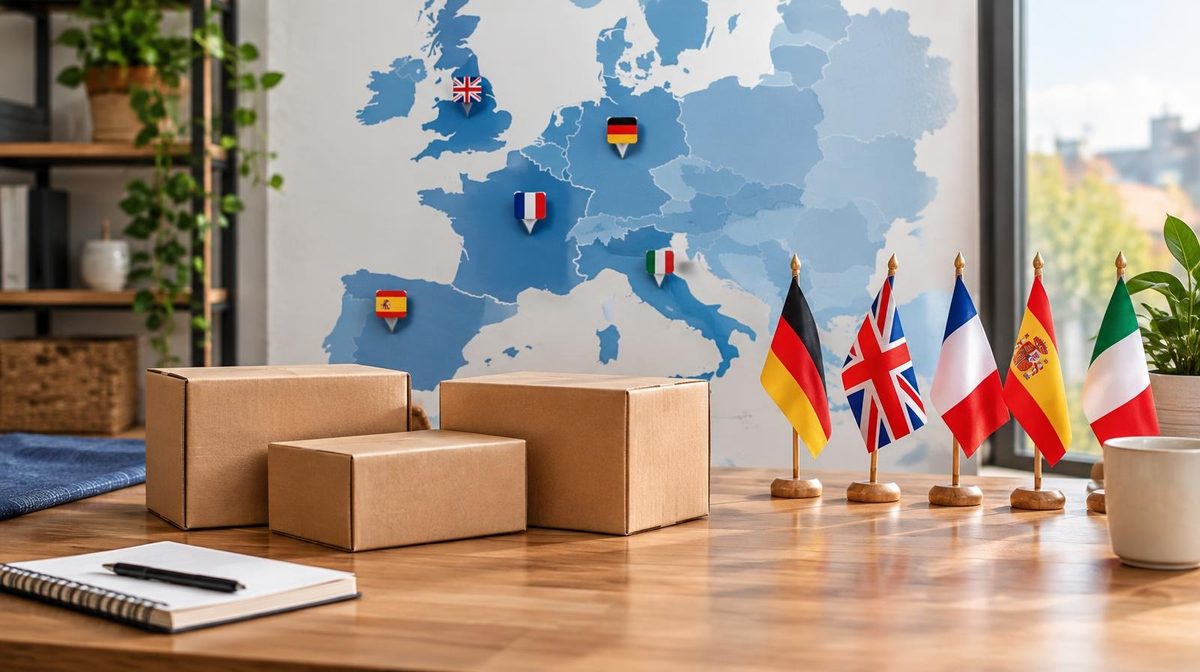
Tomás opened five European marketplaces in one afternoon. Eleven weeks later he had spent €4,100 on tax registrations to earn €2,860 in revenue.
Build International Listings pushed his catalog to Germany, France, Italy, Spain and the Netherlands. The listings went live in about twenty minutes and he told his team they had just gone international.
What he actually had, by week eleven, was VAT registration and filing fees in four countries, a French listing suspended for a missing compliance document, and $1,900 spent on ads pointing at listings whose machine-translated German and Italian were bad enough that shoppers bounced.
The expansion was not the mistake. Doing all five at once, with no local research and no plan for the part that actually costs money, was.
Amazon Global Selling is the biggest untapped lever most established sellers have. It is also the fastest way to turn a profitable business into a compliance project if you treat it as a copy-paste job. This guide covers what the program actually is, how to pick the one marketplace worth opening first, the real cost stack nobody puts in the brochure, and how to launch advertising in a country where you have zero sales history.
What Amazon Global Selling Actually Is
Amazon Global Selling is not a separate product you buy. It is the umbrella term for the tools and account structures that let one seller list and ship into Amazon's 20+ marketplaces without incorporating a company in every country.
Three things sit under that umbrella:
- Unified accounts: one login covers a whole region. A North America Unified Account gives you amazon.com, amazon.ca and amazon.com.mx. A Europe account covers the UK, Germany, France, Italy, Spain, the Netherlands, Sweden, Poland and Belgium. The Far East region covers Japan, Australia and Singapore.
- Build International Listings (BIL): a tool that copies a listing from a source marketplace to target marketplaces and keeps price and inventory synced against a rule you set.
- Cross-border fulfillment programs: Remote Fulfillment with FBA, the European Fulfillment Network, Pan-European FBA and Amazon's Global Logistics freight service.
Registration itself is free. You pay the $39.99 monthly Professional plan once per region, not once per marketplace, which is why opening a second country inside a region you already sell in is cheap and opening a new region is not.
The official Amazon Global Selling hub walks through the registration mechanics. What it will not tell you is which marketplace deserves your money, so start there.
Pick One Marketplace, Not Five
The instinct to open everything at once comes from a reasonable place: the marginal effort of adding a fifth country to a BIL push is about four clicks. The marginal cost is not marginal at all, because every live marketplace carries its own tax registration, its own compliance filings, its own return flow and its own ad budget.
Score your candidates on five factors before you open anything.
1. Demand for your exact category
Not the market's total size. Search a handful of your head keywords on the target marketplace and look at the depth of the results. Twenty established listings with 500+ reviews means a real market with real competition. Six thin listings means either an opportunity or a category nobody buys there.
2. Competitive gap
Check whether the top listings are localized properly. A German page written in obviously machine-translated German, with US-format dimensions and no EU compliance information, is a seller who expanded lazily. That is your opening.
3. Language distance
The UK, Canada and Australia need spelling changes and unit conversions. Germany, France, Japan and Mexico need real translation plus real cultural adaptation. Budget accordingly.
4. Compliance load
This is the factor sellers underweight most. Selling into the EU means VAT registration, an EU Responsible Person, EPR registrations per country per product category, and GPSR labeling. Selling into Canada or the UK is far lighter.
5. Margin after the new cost stack
Landed cost changes. Referral fees are the same percentage but on a different price point. Fulfillment fees differ by country. Run the numbers before, not after.
For most US sellers the honest first move is Canada or the UK. For most EU sellers it is the US or the UK. Pick the one where language distance and compliance load are lowest, prove the model works, then use that revenue to fund a harder market.
Pro Tip: Run Build International Listings in price-comparison mode and let it show you the auto-calculated price in the target marketplace before you commit. If that price lands below your break-even after the local fee stack, you have your answer without spending anything.
The Real Cost Stack of Opening a Marketplace
Here is what a first-year expansion into a single new marketplace actually costs a mid-size seller. Figures are typical ranges, not quotes.
| Cost line | US → Canada | US → UK | US → Germany |
|---|---|---|---|
| Professional plan (new region) | $0 (same region) | ~$470/yr | ~$470/yr |
| VAT / GST registration + filings | $400–$900 | $600–$1,500 | $900–$2,000 |
| Product compliance & labeling | $0–$300 | $300–$1,200 | $800–$3,000 |
| Translation & listing localization | $150–$400 | $150–$400 | $600–$1,500 |
| PPC launch budget (90 days) | $900–$3,000 | $1,200–$4,000 | $1,500–$5,000 |
Two lines deserve attention.
Compliance is the swing factor. The gap between Canada and Germany on that row is the entire reason "just open everything" fails. EU marketplaces require an EU-based Responsible Person for most product categories, Extended Producer Responsibility registration numbers for packaging, batteries, electricals and textiles, and General Product Safety Regulation labeling. Each of those is a per-country, per-category registration with an annual fee and a filing obligation. The EU One Stop Shop VAT portal simplifies the VAT filing side, but it does not touch EPR or product safety.
PPC launch budget is not optional. A new marketplace listing has zero sales history, zero reviews and zero organic rank. Ads are the only way to generate the first sales that make the organic engine start turning. Budget for it up front or your listing sits on page nine forever.
Fulfillment: Four Ways to Get Product There
Your fulfillment choice determines your delivery promise, your fee stack and whether you need to physically ship inventory abroad before you know if the market works.
- Remote Fulfillment with FBA: Amazon ships from your existing FBA inventory in one country to customers in another. No new inventory shipment. Delivery is slower and fees are higher per unit. This is the correct way to test a marketplace and a poor way to scale one.
- European Fulfillment Network (EFN): store in one EU country, Amazon fulfills orders from other EU marketplaces out of that stock. Per-unit cross-border fee, but one inventory pool. A good middle step.
- Pan-European FBA: Amazon distributes your inventory across EU fulfillment centers at local fulfillment rates. Cheapest per unit and the fastest delivery promise, which matters for the Buy Box. The catch: holding stock in a country creates a VAT registration obligation there.
- Local FBA or a 3PL: ship a container in and use standard local FBA. Best unit economics once volume justifies it, but it ties up capital in a market you have not proven.
The sequence that works: Remote Fulfillment or EFN to validate, then local FBA or Pan-EU once a marketplace clears a revenue threshold you set in advance. If you are still deciding between Amazon fulfillment and handling shipping yourself in the new market, our FBA vs FBM breakdown runs both fee stacks side by side, and the Amazon FBA fees guide covers how those fees change once you cross a border.
Translation Is Not Localization
Priya sold a kitchen scale that did $340,000 a year on amazon.com. She pushed it to amazon.de through BIL, accepted the auto-translation, and watched a 2.1% conversion rate against 11% at home.
The listing said the scale measured to 0.1 oz. It gave dimensions in inches. The A+ content showed a US measuring cup. The bullet points were grammatical German that no German shopper would ever have written.
Localization means five specific things:
- Real translation by someone who sells in that market. Not the BIL auto-translation, and not a generic translation service that has never seen an Amazon listing.
- Native units and formats. Grams, centimeters, Celsius, 24-hour time, DD.MM.YYYY dates, local plug types shown in images.
- Keyword research done in the target language. German shoppers do not search the translation of your English keyword. They search a different word, often a compound noun with no English equivalent.
- Local compliance content on the page. EU listings need Responsible Person details and safety information visible. Missing it gets listings suppressed.
- Images that make sense locally. Lifestyle photos shot in a recognizably American kitchen read as foreign in Munich.
Our Amazon listing optimization guide covers the on-page mechanics. Apply every one of them again, from scratch, in the new language. A translated listing is a draft, not a finished listing.
Note: Run your translated bullets past one native-speaking customer or freelancer before you spend a dollar on ads. It is the cheapest quality gate in the entire expansion.
Launching PPC in a Market With No History
This is the part most global selling guides skip entirely, and it is where the money goes.
Ryan expanded his supplement brand from the US to the UK and exported his American campaign structure wholesale: same keywords translated, same bids, same 22% ACoS target. Six weeks in, UK ACoS sat at 68%. He blamed the market.
The market was fine. The approach was wrong in three ways.
Your ACoS target should be different. Break-even ACoS is a function of margin, and margin in the new market is not what it is at home. VAT-inclusive pricing in Europe means your displayed price includes 19-21% tax that never reaches you. A product carrying a 35% margin in the US might carry 24% in Germany at the same displayed price. Recalculate break-even before you set a target, and set the launch target above break-even deliberately, because you are buying rank, not profit, in month one.
Your keywords do not transfer. Translating a US keyword list produces terms nobody searches. Start every new marketplace with auto campaigns and broad match discovery, harvest what actually converts, then build exact-match campaigns from real local data. It costs more in month one and saves you a quarter of wasted spend after that.
CPCs and competitive density are local. Amazon.co.uk CPCs typically run lower than amazon.com in the same category. Amazon.de is often lower still. Amazon.co.jp behaves differently again. Importing US bids either overpays or gets you no impressions, and you will not know which without local data.
The structure that works for a new marketplace launch is deliberately simple: one auto campaign for discovery, one broad-match manual campaign seeded with locally researched terms, and one exact-match campaign that you build only after 30 days of real search term data. Our campaign structure framework scales up from there, and the European sellers PPC guide goes deeper on EU-specific bidding and how VAT moves your ACoS math.
💡 Daniks.AI Advantage: Every marketplace you open is another set of campaigns to watch, in another currency, on another schedule. Daniks.AI manages amazon.com, .co.uk, .de, .fr, .es, .it and .ca from one dashboard, with a separate ACoS target per marketplace. Set 22% for your proven US account and 40% for the German launch, and the AI runs both without you opening two consoles.
A 90-Day Expansion Timeline
- Days 1-14, research and decision: score candidate marketplaces on the five factors. Pull competitor listings. Get a compliance quote for your specific product categories. Model margin after the local fee stack. Commit to exactly one marketplace.
- Days 15-30, compliance and account setup: start VAT/GST registration first because it has the longest lead time. Appoint an EU Responsible Person if required. File EPR registrations. Register the marketplace on your existing regional account.
- Days 31-45, listing build: local keyword research, professional translation, rebuilt images and A+ content with local units and context, required compliance content. Do not ship BIL auto-translation as final copy.
- Days 46-60, inventory and first sales: enable Remote Fulfillment or EFN. Confirm the delivery promise displays correctly. Place a test order yourself and check the full customer experience, including returns.
- Days 61-90, PPC launch and harvest: launch auto plus broad campaigns at a deliberately loose ACoS target. Review search terms weekly. Build exact-match campaigns from converting terms after 30 days of ad activity.
Watch account health closely through the whole window, because new marketplaces are where policy violations surface first.
Set a go/no-go threshold before day one. Something like: if the marketplace has not reached $3,000 in monthly revenue at or below a 45% ACoS by day 120, we pause and reassess. Deciding the threshold in advance is what stops a bad market from quietly bleeding you for two years.
Five Mistakes That Cost Real Money
- Opening every marketplace in a region at once. Every live marketplace is a recurring compliance obligation, not a free listing.
- Treating BIL auto-translation as finished copy. It gets you live. It does not get you converting.
- Storing inventory before validating demand. Pan-EU triggers VAT registrations in every country holding your stock. Do it after the market is proven, not before.
- Copying home-market bids and ACoS targets. Different CPCs, different margins after local tax, different competitive density.
- Ignoring returns and customer service. EU consumers have a statutory 14-day right of withdrawal. Response-time expectations and language requirements are local. Factor the support load in.
Frequently Asked Questions
How much does Amazon Global Selling cost?
Registration is free. You pay one Professional selling plan per region, roughly $39.99 per month, plus per-marketplace VAT registration and filing, compliance registrations, and standard referral and fulfillment fees. A realistic first-year budget for one new European marketplace is $3,000 to $8,000 including ad spend.
Do I need a company in the country I sell into?
No. Amazon Global Selling exists so you can sell into a marketplace using your existing entity. You will need local tax registration (VAT or GST), and in the EU an EU-based Responsible Person for most product categories, but not a local company.
Which Amazon marketplace should I expand to first?
Whichever one combines real demand for your category with the lowest language and compliance distance from your home market. For US sellers that is usually Canada or the UK. For UK and EU sellers it is usually the US.
Can I use my existing FBA inventory to sell internationally?
Yes, through Remote Fulfillment with FBA in North America or the European Fulfillment Network in Europe. Amazon ships from stock you already hold. Fees are higher per unit and delivery is slower, which makes it the right tool for testing a market and the wrong one for scaling it.
How long does international expansion take to become profitable?
Plan for six to nine months to profitability in a new marketplace, with months one to three running at a loss while you buy organic rank through ads. Sellers who expect profit in month two either pull out too early or underinvest in the launch.
Does Build International Listings translate my listings?
It machine-translates them, which is enough to go live and not enough to convert. Treat the output as a first draft and replace it with real localized copy before you start advertising.
The Move That Actually Works
Amazon Global Selling rewards sellers who go deep in one new market before going wide across five. The mechanics are genuinely easy now, and that is exactly the trap: the click that opens a marketplace is free, and everything that happens after it is not.
Pick one marketplace where your category already sells and the compliance load is survivable. Budget the full cost stack, including the ad spend that buys your first rank. Localize the listing properly instead of shipping a translation. Launch PPC on local data with a local ACoS target, not an imported one. Set your go/no-go number before you start.
Do that once, prove it, and the second marketplace takes half the time and a third of the anxiety. That is how Amazon Global Selling turns from a compliance project into a growth channel.
Ready to run PPC in every marketplace without doubling your workload?
Daniks.AI manages campaigns across amazon.com, .co.uk, .de, .fr, .es, .it and .ca from one dashboard, with a separate ACoS target for every market. Set your targets once and let the AI handle the daily work.
Start Your Free 14-Day Trial14-day free trial · Cancel anytime