
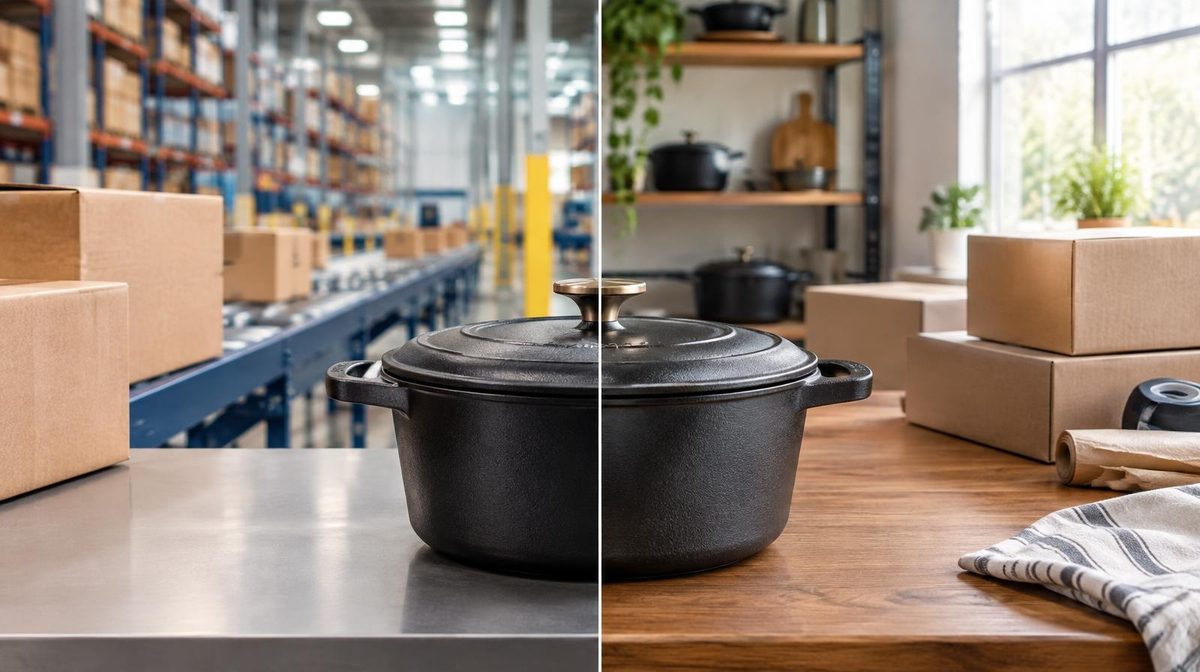
Marco ran the same product two ways for ninety days, on purpose.
He sells a 9-pound cast iron dutch oven at $89. Half his inventory sat in Amazon's warehouses on FBA. The other half shipped from a 900-square-foot unit he rents twenty minutes from his house, on FBM. Same listing price, same photos, same ad campaigns pointed at the parent ASIN.
FBA moved 412 units. FBM moved 71.
That looks like a landslide until you put the two columns next to each other. The FBA units netted him $11.20 each after every fee. The FBM units netted $19.60, because he was paying a regional carrier $6.40 to move a heavy box instead of paying Amazon $12.80 to do it. FBA earned him $4,614. FBM earned $1,391 on one-sixth the volume.
So which one won? Neither, cleanly. And that is the honest answer most Amazon FBA vs FBM comparisons refuse to give you, because it doesn't make for a tidy conclusion.
The real question is not which fulfillment method is better. It is which method is better for this specific ASIN, at this weight, at this price, at this sales velocity, given how much of your own labor you're willing to spend. That answer changes per product, and it changes again when your volume doubles.
Here's how to work it out for your catalog.
What FBA and FBM Actually Mean
FBA (Fulfilled by Amazon) means you ship inventory into Amazon's fulfillment network. Amazon stores it, picks it, packs it, ships it, handles customer service, and processes returns. Your listing gets the Prime badge automatically.
FBM (Fulfilled by Merchant), sometimes called MFN or Merchant Fulfilled Network, means the inventory stays with you. When an order comes in, you pick it, pack it, buy the label, and ship it. You handle the customer emails and the returns.
That's the textbook version, and it's where most guides stop. The part that matters more is what each model does to three things: your margin per unit, your Buy Box position, and your cash cycle.
Referral fees are identical in both models — Amazon takes its 8-17% commission on the sale regardless of who ships the box. Everything else is different.
The Fee Math, Side by Side
Let's take one product and run it through both models honestly. A 2-pound kitchen gadget, 10 x 7 x 4 inches, selling at $34.99, cost of goods $8.50.
| Line item | FBA | FBM |
|---|---|---|
| Sale price | $34.99 | $34.99 |
| Referral fee (15%) | $5.25 | $5.25 |
| Fulfillment fee | $6.15 | $0 |
| Outbound shipping (your cost) | $0 | $7.90 |
| Packaging materials | $0 | $0.65 |
| Monthly storage (prorated) | $0.28 | $0.11 |
| Pick/pack labor | $0 | $1.40 |
| Returns handling (blended) | $0.85 | $0.55 |
| Cost of goods | $8.50 | $8.50 |
| Net per unit | $13.96 | $10.63 |
On this product, FBA wins by $3.33 per unit, and it isn't close. Amazon's negotiated shipping rates on a small, light, fast-moving item are genuinely hard to beat. If you're selling anything under three pounds at a healthy velocity, FBA is usually the correct default and you can stop reading the fee comparison here.
Now change one variable. Make it Marco's 9-pound dutch oven at $89.
| Line item | FBA | FBM |
|---|---|---|
| Sale price | $89.00 | $89.00 |
| Referral fee (15%) | $13.35 | $13.35 |
| Fulfillment fee | $12.80 | $0 |
| Outbound shipping (your cost) | $0 | $6.40 |
| Packaging materials | $0 | $1.10 |
| Monthly storage (prorated) | $1.35 | $0.40 |
| Pick/pack labor | $0 | $2.10 |
| Returns handling (blended) | $2.10 | $1.15 |
| Cost of goods | $38.20 | $38.20 |
| Net per unit | $21.20 | $26.30 |
Same seller, same account, opposite conclusion. Weight and cube are the whole story. Amazon's fulfillment fees scale steeply with size tier, while a regional carrier contract or a flat-rate service scales far more gently. Somewhere between two and six pounds, depending on your category and your negotiated rates, the lines cross.
If you don't already know your exact per-unit fee stack, pull it before you make any decision here. Our complete breakdown of Amazon FBA fees walks through every line item and where the surprises hide, and Amazon publishes current rates in the FBA fee schedule inside Seller Central.
Pro Tip: Run this table for your top 10 ASINs by revenue, not for your catalog average. Averages hide the two heavy products that are quietly funding Amazon's warehouse network out of your margin.
Where FBA Genuinely Wins
The Prime Badge and the Buy Box
This is the argument that outweighs fee math for most sellers, and it's real. FBA listings get the Prime badge automatically. Prime members convert at a meaningfully higher rate than non-Prime offers on the same product, and Amazon's Buy Box algorithm weights fulfillment method heavily.
An FBM offer can win the Buy Box, but it has to overcome a handicap: slower promised delivery, no Prime badge, and a seller-performance record Amazon trusts less than its own warehouses. Practically, that often means pricing 5-12% below the FBA competition to hold the same Buy Box share — which erases the fee savings you calculated above. If you're not clear on how Amazon actually awards it, our Buy Box guide covers the weighting in detail.
Scale Without Headcount
Marco's FBM channel moved 71 units in ninety days. That was roughly six hours a week of picking, packing, and label buying. At 400 units it would have been a part-time employee. At 2,000 units it would have been a warehouse manager, a shift, and a whole second business he didn't want to run.
FBA's real product isn't shipping. It's the fact that your unit economics don't change when volume triples. That's worth a few dollars per unit to almost everyone.
Customer Service and Returns
Amazon absorbs the "where is my order" emails, the refund decisions, and the return logistics. On FBM, every one of those lands in your inbox and counts against your Order Defect Rate if you mishandle it. Sellers consistently underestimate this cost until they're living it.
Multi-Channel Fulfillment
If you sell on Shopify, eBay, or your own site, FBA inventory can fulfill those orders too through Multi-Channel Fulfillment. One inventory pool, several sales channels. FBM gives you that flexibility natively, but only if you're already running a warehouse.
Where FBM Genuinely Wins
- Heavy, bulky, or low-margin products: anything above roughly five pounds, anything oversize, anything where cube is high relative to price. FBA fee tiers punish these products specifically, and a regional carrier or LTL setup will usually beat Amazon's rate card.
- Slow-moving inventory: Amazon charges monthly storage on cubic feet, with sharp surcharges once inventory ages past 181 and 271 days, plus low-inventory and aged-inventory penalties layered on top. A product that sells eight units a month and sits for a year can accumulate more in storage fees than it earns in margin.
- Handmade, custom, fragile, or regulated goods: personalized engraving, made-to-order items, cold chain, hazmat, or anything Amazon's warehouse won't handle cleanly. FBM isn't a choice here — it's the only path.
- Cash flow control: FBA locks cash in a warehouse three states away. FBM lets you hold stock closer and ship as orders arrive. For sellers financing growth out of operating cash rather than a credit line, that difference is not academic.
- Testing new products: launching an unproven SKU on FBM validates demand without committing a shipment. If it flops, you're holding boxes in your own space, not paying removal fees on a mistake.
Once a test product proves out, converting it to FBA is straightforward — our inventory management guide covers the reorder math once a product graduates.
Seller Fulfilled Prime: The Third Option
Seller Fulfilled Prime (SFP) is the hybrid most sellers forget exists. You ship from your own warehouse and still display the Prime badge — if you can meet Amazon's standards.
Those standards are strict. You need to pass a trial period, ship the vast majority of orders on time, offer weekend pickup and delivery, use Amazon's Buy Shipping for nearly all orders, and maintain a cancellation rate under 0.5%. Amazon publishes the current requirements on its Seller Fulfilled Prime page.
SFP makes sense for one specific profile: sellers with heavy or bulky products, real fulfillment infrastructure already in place, and enough volume to justify the operational discipline. If that's you, SFP gives you FBM's fee structure with FBA's conversion rate. If it isn't you, the trial period will tell you quickly and expensively.
💡 Daniks.AI Advantage: Daniks.AI reads actual profitability per ASIN, not just ad revenue — so when you flip a heavy product from FBA to FBM and its margin jumps six points, your bids move with it automatically instead of waiting for you to remember to update a target.
The Part Nobody Connects: Fulfillment Changes Your Break-Even ACoS
This is where the FBA vs FBM decision stops being an operations question and becomes an advertising question.
Your break-even ACoS is simply your profit margin before ad spend. Sell at a 30% margin and you break even on an advertised sale at 30% ACoS. Sell at 20% and you're losing money above 20%.
Fulfillment method moves that margin, which moves your entire bidding ceiling.
Take Marco's dutch oven again. On FBA he nets $21.20 on an $89 sale — a 23.8% margin, so break-even ACoS is 23.8%. On FBM he nets $26.30, a 29.5% margin, so break-even climbs to 29.5%.
That's not a rounding difference. It means his FBM listing can profitably bid roughly 24% higher on the same keyword and still make money. In a competitive auction, that's the difference between top-of-search placement and page two.
Now run it the other way. A seller who moves a light product from FBA to FBM to "save on fees" and instead loses $3 of margin per unit has quietly cut their break-even ACoS by nine points — and if their target ACoS didn't move, every campaign is now spending them into a loss on a listing that looks fine in the ad console.
Three rules fall out of this:
- Recalculate target ACoS every time you change fulfillment method on a SKU. Not next quarter. That week.
- Never set one target ACoS across a mixed FBA/FBM catalog. Two products with a nine-point margin gap need two different targets, and a portfolio-level setting will systematically over-bid on one and under-bid on the other.
- Treat fee increases as ACoS changes. When Amazon raises fulfillment rates in January, your break-even ACoS drops on every FBA SKU that day, whether or not you adjust anything.
If your targets haven't been revisited since your last fee change, our guide on how to lower ACoS on Amazon is the fastest place to start.
A Decision Framework You Can Run in Ten Minutes
Take any ASIN and answer these in order.
- What does it weigh, and what's its size tier? Under 2 lbs and small standard: default to FBA. Over 5 lbs or oversize: run the FBM math seriously.
- How fast does it sell? More than 30 units a month: FBA's velocity advantage and storage efficiency usually win. Under 10 units a month: storage fees are eating you, consider FBM.
- What's your margin before ads? Under 25%: every fee dollar matters, and FBM deserves a hard look on anything heavy. Over 40%: FBA's convenience is cheap insurance, take it.
- Can you actually ship it on time, every time? Late Shipment Rate above 4% or a Cancellation Rate above 2.5% will cost you the Buy Box and eventually your account health.
- Is the Buy Box contested? If you're the only seller on your own branded listing, FBM's handicap barely matters. If you're fighting six resellers on a shared ASIN, FBA is close to mandatory.
- Does the product have anything unusual about it? Fragile, custom, hazmat, oversized, temperature-sensitive, bundled at the point of sale: FBM or nothing.
Score six clean FBA answers and the decision is made. Mixed answers usually mean the product belongs in a hybrid setup.
Running Both: The Hybrid Setup Most Established Sellers Land On
You do not have to choose one model for your whole catalog. Most sellers doing seven figures run both, and the split usually looks like this:
- FBA: the small, light, fast movers. The proven winners. Anything on a contested listing.
- FBM: the heavy items, the slow movers, the oversized SKUs, new products in testing.
- Both on the same ASIN: FBA as the primary offer, FBM as a backup that catches demand when FBA inventory runs out.
That last one is underrated. An FBM offer sitting behind your FBA offer means a stockout costs you rank instead of costing you the listing entirely. Sales velocity keeps running, your organic position survives the gap, and your ad campaigns don't have to be paused and rebuilt.
Dana, who sells outdoor gear in three size classes, does exactly this. Her 1-pound headlamps are FBA-only. Her 22-pound tents are FBM-only. Her mid-weight sleeping bags run FBA with an FBM backup, and during the two weeks last September when her FBA replenishment sat stuck in a receiving queue, the FBM offer took 180 orders that would otherwise have been zeros. Her keyword rank never dropped.
Note: Running an FBM offer at a higher price to compensate for shipping costs while an FBA offer exists on the same ASIN can create Buy Box conflicts and confuse your own pricing rules. Set the FBM price deliberately, not as an afterthought.
Five Mistakes That Cost Real Money
- Comparing fulfillment fee to shipping cost and stopping there. Packaging, labor, storage, and returns are real costs. Marco's FBM number only worked because he counted the $2.10 of labor per unit instead of pretending his own time was free.
- Ignoring the return rate difference. FBA returns are frictionless for the customer, which means more of them. On some categories the FBA return rate runs several points higher than FBM on the identical product.
- Switching a whole catalog at once. Move two or three SKUs, run them for sixty days, and compare actual settlement data. Marco's ninety-day split test cost him nothing and told him more than any spreadsheet.
- Forgetting that FBM changes your delivery promise. A 5-day handling window shows the customer a later delivery date, and later delivery dates convert worse. If you go FBM, tighten handling time to 1 day and let your rates reflect it.
- Leaving ad targets untouched after the switch. The most expensive mistake here because it's invisible. The ad console will show the same ACoS it always did while actual profit per order has moved.
Sellers running lean budgets should read our notes on Amazon PPC on a small budget before scaling spend on a newly-switched SKU.
Frequently Asked Questions
Is FBA or FBM more profitable?
It depends almost entirely on weight and velocity. For products under about 2 pounds selling more than 30 units a month, FBA is usually more profitable after all costs. For products over 5 pounds or moving fewer than 10 units a month, FBM often nets more per unit. Run both fee stacks on your actual numbers before deciding.
Can I use FBA and FBM at the same time?
Yes. You can run different fulfillment methods on different ASINs, and you can list both an FBA and an FBM offer on the same ASIN. Many established sellers keep FBM as a stockout backup behind their FBA offers.
Does FBM hurt my Buy Box chances?
It makes winning harder but not impossible. FBA offers carry an advantage in Amazon's Buy Box weighting through the Prime badge and faster promised delivery. FBM sellers typically need better pricing, strong seller metrics, and fast handling times to compete — or Seller Fulfilled Prime.
Do FBM listings get the Prime badge?
Only through Seller Fulfilled Prime, which requires qualifying through a trial period and meeting strict delivery, weekend-shipping, and cancellation-rate standards. Standard FBM listings do not show the Prime badge.
How do I switch a listing from FBA to FBM?
In Seller Central, edit the offer and change the fulfillment channel to "I will ship this item myself." Any inventory already in Amazon's warehouses needs a removal or disposal order first, which carries its own per-unit fee. Plan the switch around a natural inventory low point, not mid-restock.
Is FBM better for new sellers?
Often yes, for testing. FBM lets you validate a product without committing a shipment and paying storage on inventory that may not sell. Once demand is proven, converting to FBA is straightforward.
The Bottom Line
There is no universal winner in the Amazon FBA vs FBM debate, and anyone selling you one is selling you something.
FBA wins on light, fast-moving, contested products where the Prime badge and hands-off scale are worth more than the fee. FBM wins on heavy, slow, oversized, or unusual products where Amazon's fee tiers stop making sense and you have the operational discipline to ship reliably. Most real catalogs need both.
What matters more than picking correctly is remembering that the choice reaches further than the warehouse. Every time you change how a product gets to the customer, you change what it earns — and what it earns is what decides how hard your ads can bid on it.
Marco kept his dutch oven on FBM and moved his lighter cookware to FBA. Then he did the thing most sellers skip: he set separate ACoS targets for the two groups. His overall ad spend went up 11%. His profit went up 34%.
The fulfillment decision got him halfway. The bidding decision got him the rest.
Ready to Automate Your Amazon PPC?
Daniks.AI sets and holds your target ACoS per product, so your bids follow your real margins — whether a SKU ships from Amazon's warehouse or yours.
Start Your Free 14-Day Trial14-day free trial · Cancel anytime