
A seller we work with launched on Amazon.de last year with a product that was already doing $40K per month in the US. He copied his American campaigns, translated the keywords with Google Translate, set the same bids, and waited. After 60 days, his ACoS on the German marketplace was 67%. He had spent over EUR 8,000 with barely enough sales to cover shipping.
His product was fine. His strategy was the problem. Amazon PPC in Europe does not work like Amazon PPC in the United States, and the sellers who treat EU marketplaces as copy-paste extensions of their US accounts burn money every single month.
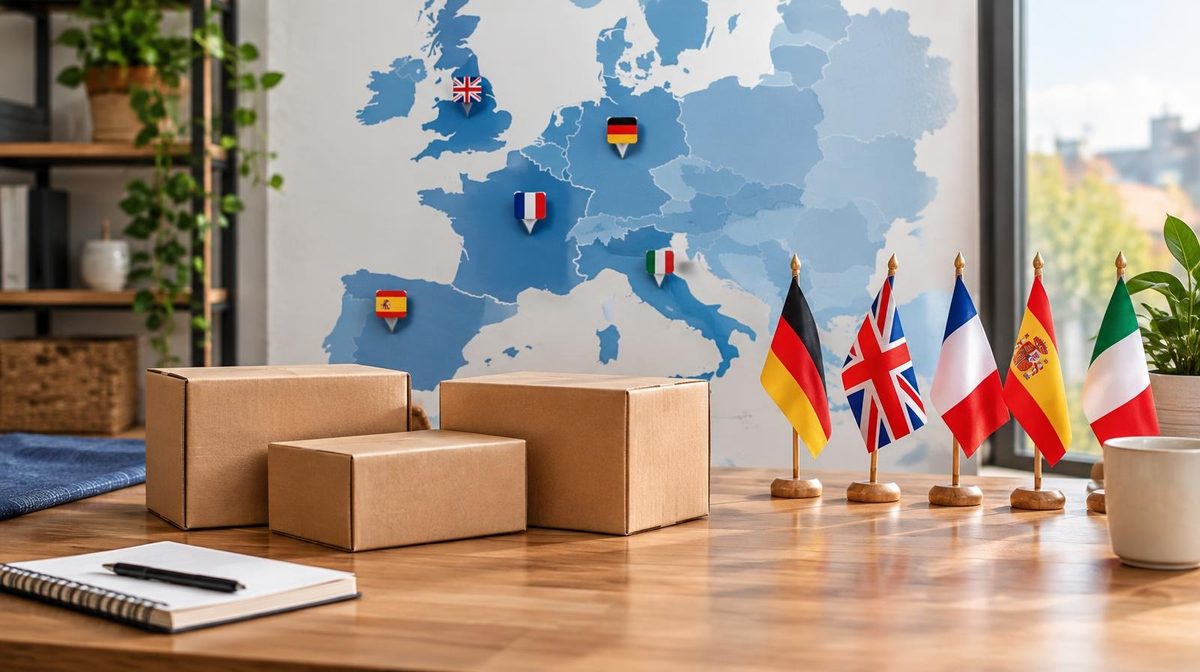
Europe is five major marketplaces (Germany, the United Kingdom, France, Spain, and Italy), each with its own search behavior, competition levels, CPCs, and buyer expectations. Running profitable PPC across them requires a different playbook than the one that works on amazon.com.
This guide covers the marketplace-specific strategies, budget frameworks, and keyword approaches that actually work for Amazon PPC European sellers in 2026. Whether you are expanding from the US or building a European-first business, the principles here will save you thousands in wasted ad spend.
Why Amazon PPC in Europe Is Different From the US
The mechanics are the same. Sponsored Products, Sponsored Brands, Sponsored Display: they all exist in Europe. Campaign Manager looks identical. The advertising console works the same way. That surface-level familiarity is exactly what gets sellers into trouble.
Lower CPCs, but Lower Conversion Rates
Average CPCs across European marketplaces are typically 30-50% lower than the US. That sounds great until you realize conversion rates are often lower too, especially for sellers without localized listings. A EUR 0.35 click that converts at 4% costs you more per sale than a $0.80 click that converts at 12%.
The math that matters is cost per acquisition, not cost per click.
Fragmented Search Volume
In the US, you have one massive marketplace with 200+ million Prime members searching in one language. In Europe, you have five marketplaces, four languages, and wildly different search volumes. A keyword with 50,000 monthly searches on amazon.com might get 3,000 on amazon.de and 800 on amazon.fr.
That fragmentation changes everything about how you plan campaigns, set budgets, and evaluate performance.
Different Competitive Landscapes
Amazon.de is the most competitive European marketplace. According to Marketplace Pulse, it is the second-largest Amazon marketplace globally. The UK follows closely. France, Spain, and Italy are significantly less competitive, which means lower CPCs but also smaller addressable markets.
For a breakdown of who is actually selling on these marketplaces, our research found that 57% of Amazon.de sellers are based in China, which has major implications for competition and pricing strategies.
VAT and Margin Implications
European sellers deal with Value Added Tax (VAT) ranging from 19% (Germany) to 22% (Italy). That 19-22% hits your margins before you even think about advertising costs. Your break-even ACoS calculation in Europe must account for VAT, which most US-focused PPC guides ignore entirely.
Break-even ACoS formula for EU:
Break-even ACoS = ((Sale Price - Product Cost - FBA Fees - VAT) / Sale Price) x 100
If your product sells for EUR 29.99 with EUR 8 in product costs, EUR 7 in FBA fees, and EUR 4.79 in German VAT (19%), your pre-ad margin is EUR 10.20, giving you a break-even ACoS of roughly 34%. Compare that to the same product in the US with no sales tax deducted, and you will see why EU target ACoS needs to be tighter. For a deeper dive into calculating and optimizing this metric, see our complete Amazon ACoS guide.
Marketplace-by-Marketplace PPC Breakdown
Not all European marketplaces deserve equal ad spend. Here is what you need to know about each one.
Amazon.de (Germany) — The Big One
Germany is the largest European marketplace and usually where serious EU sellers start. It is also the most competitive.
What to expect:
- Highest search volume in Europe
- Average CPCs between EUR 0.25-0.60 for most categories
- Strong competition from Chinese sellers, especially in electronics, home, and kitchen
- German shoppers are detail-oriented — they read bullet points, check specifications, and compare thoroughly before buying
- 19% VAT
PPC strategy for Germany:
- Invest in proper German keyword research (not translation — research). "Hundeleine" and "Leine fuer Hunde" target different intents
- Bid more aggressively on exact match. German compound words mean broad match can spiral quickly
- Budget allocation: 40-50% of your total EU ad spend should go to Germany if you sell in all five marketplaces
- Focus on Sponsored Products first. Sponsored Brands require German-language headlines that sound natural, not translated
Still weighing the German expansion itself, beyond the ads? Our founder Katia took her Daniks cookware brand to Top-1 in Germany; her TheFBAGirl comparison of Amazon.de vs Amazon.com for sellers covers the fee, VAT, and shopper-behavior differences that decide whether Germany is worth it for your catalog.
Amazon.co.uk (United Kingdom) — Familiar but Different
The UK marketplace is closest to the US in language and buying behavior, but post-Brexit logistics and regulations create real differences.
What to expect:
- Second-largest European marketplace by revenue
- CPCs slightly lower than US, higher than continental Europe
- English-language keywords, but British spelling and terminology matter (colour, tumble dryer, nappy, boot of the car)
- Post-Brexit: separate inventory required, customs considerations
- 20% VAT
PPC strategy for UK:
- Create UK-specific keyword lists. "Stroller" is "pushchair" or "pram". "Diaper" is "nappy". "Cell phone case" is "mobile phone case". Getting this wrong means your ads show for the wrong queries
- UK shoppers respond well to Sponsored Brands with Store Spotlight — brand trust matters in this market
- Budget allocation: 25-35% of EU ad spend
Amazon.fr (France) — Underrated Opportunity
France is often overlooked by US sellers expanding to Europe, but it has a solid customer base and significantly less PPC competition.
What to expect:
- Third-largest European marketplace
- CPCs are typically 40-60% lower than Germany
- Less competition means easier organic ranking alongside PPC
- French shoppers expect fully localized listings — poor translations kill conversion rates
- 20% VAT
PPC strategy for France:
- Professional French translation is non-negotiable. French buyers will not purchase from a listing with Google Translate French
- Start with auto campaigns to discover actual French search terms — your assumptions about what French shoppers search for are probably wrong
- Lower CPCs mean you can afford broader match types with less risk
- Budget allocation: 10-15% of EU ad spend
Amazon.es (Spain) and Amazon.it (Italy) — Low-Hanging Fruit
Spain and Italy are the smallest of the five major EU marketplaces, but their low competition makes them high-ROI opportunities for sellers already in Europe.
What to expect:
- Lowest CPCs in Europe (often EUR 0.10-0.30)
- Significantly less PPC competition
- Smaller search volumes
- Spanish and Italian localization required
- VAT: 21% (Spain), 22% (Italy)
PPC strategy for Spain and Italy:
- These marketplaces reward simply showing up with localized listings and running basic PPC
- Auto campaigns perform surprisingly well because competition for ad slots is low
- Do not ignore them — many sellers running in DE and UK skip ES and IT, leaving easy sales on the table
- Budget allocation: 5-10% of EU ad spend each
How to Structure Your EU PPC Campaigns
The biggest mistake European sellers make is running one set of campaigns across all marketplaces. Each marketplace needs its own campaign structure because keywords, bids, and performance vary dramatically.
The Multi-Marketplace Campaign Framework
For each product, set up this structure per marketplace:
- Auto campaign — Let Amazon discover local search terms. This is especially important in non-English markets where you cannot predict search behavior
- Broad match campaign — Capture variations of your core keywords in the local language
- Exact match campaign — Your proven converters harvested from auto and broad campaigns
- Product targeting campaign — Target competitor ASINs. Works the same across all marketplaces
This mirrors the campaign structure framework we recommend for US sellers, adapted for the multi-marketplace reality.
Naming Convention That Saves Your Sanity
When you manage campaigns across five marketplaces, clear naming prevents chaos:
[Marketplace]-[Product]-[Match Type]-[Campaign Type]
Examples: DE-DogLeash-Exact-SP • UK-DogLeash-Auto-SP • FR-DogLeash-Broad-SP
This makes filtering, reporting, and budget allocation across marketplaces straightforward.
Separate Budgets Per Marketplace
Never pool budgets across marketplaces. A shared budget will get eaten by your highest-traffic marketplace (usually Germany) and starve the others. Set individual daily budgets based on each marketplace's potential.
Starting budget framework for new EU expansion:
| Marketplace | % of Total EU Budget | Typical Daily Budget |
|---|---|---|
| Germany (DE) | 40-50% | EUR 30-50 |
| UK | 25-35% | EUR 20-35 |
| France (FR) | 10-15% | EUR 8-15 |
| Spain (ES) | 5-10% | EUR 5-10 |
| Italy (IT) | 5-10% | EUR 5-10 |
Adjust based on actual performance data after the first 30 days. For a deeper framework on budget allocation across campaign types, see our Amazon PPC budget strategy guide.
EU Keyword Research: Beyond Translation
This is where most sellers fail. They take their US keyword list, run it through Google Translate or DeepL, and use the output as their European keyword targets. That approach misses three critical realities.
1. Search Behavior Differs by Culture
German shoppers tend to use longer, more specific compound words. French shoppers often include brand modifiers early. Spanish and Italian shoppers frequently use shorter, more generic terms. A keyword strategy that works in the US will not map cleanly to any of these behaviors.
2. Amazon's Auto-Suggest Varies by Marketplace
The best free keyword research tool for European marketplaces is Amazon's own search bar. Type your root keyword on each marketplace and see what Amazon suggests. These suggestions reflect actual shopper behavior on that specific marketplace.
Do this for every marketplace you sell in. The suggestions on amazon.de will be different from amazon.fr, which will be different from amazon.es.
3. Compound Words in German Change Everything
German creates compound words by joining terms together. "Dog leash" becomes "Hundeleine" (one word). "Running shoes" becomes "Laufschuhe". "Wireless headphones" becomes "Kabellose Kopfhoerer".
This matters for PPC because:
- Broad match handles compound words differently than multi-word queries
- Negative keywords need to account for compound variations
- Keyword density in your listing affects Quality Score differently
Pro Tip: Use Amazon Brand Analytics on each EU marketplace (if you have Brand Registry) to see real search frequency rankings. This is the most accurate source of keyword data for European marketplaces, better than any third-party tool.
Common EU PPC Mistakes That Drain Budget
After working with hundreds of sellers running ads across European marketplaces, these are the mistakes we see most often.
Mistake 1: Using USD-Calibrated Bids in EUR Markets
Sellers expanding from the US often set bids at the same level they use in American campaigns. EUR 0.80 bids in a market where the average CPC is EUR 0.30 means you are overpaying for every click by a factor of two or three. Start low in European marketplaces and scale up based on performance data.
Mistake 2: Ignoring Negative Keywords Across Languages
A negative keyword that works in English does nothing in German campaigns. You need language-specific negative keyword lists for each marketplace. "Free" needs to be negated as "kostenlos" and "gratis" in Germany, "gratuit" in France, "gratis" in Spain, and "gratuito" in Italy.
For a full workflow on finding and adding negatives, check our Amazon negative keywords guide.
Mistake 3: Running Sponsored Brands With Translated Headlines
Sponsored Brands headlines that sound natural in English often sound robotic or unnatural when translated literally. "Shop Our Top-Rated Dog Leashes" in German should not be "Kaufen Sie Unsere Top-Bewerteten Hundeleinen". Work with native speakers or professional copywriters for SB headlines — the click-through rate difference is dramatic.
Mistake 4: Evaluating EU Campaigns on US Timelines
European campaigns typically take longer to mature because of lower search volumes. A keyword that generates enough data for a bid decision in two weeks on amazon.com might need six to eight weeks on amazon.fr. Extend your evaluation windows for EU marketplaces before cutting keywords.
Mistake 5: Skipping Pan-European FBA
Pan-European FBA distributes your inventory across Amazon's EU fulfillment centers, giving you Prime badges in all five marketplaces. Without it, your delivery times are longer, your conversion rates drop, and your PPC performance suffers. The logistics cost is worth the conversion rate lift.
Scaling EU PPC: When to Increase Spend and Where
Once your campaigns are running profitably, scaling across Europe follows a predictable pattern.
Phase 1: Establish Profitability (Months 1-2)
Focus on your primary marketplace (usually Germany or UK). Run auto and broad match campaigns to discover keywords. Set conservative target ACoS — aim for break-even or slightly above while you collect data.
Phase 2: Optimize and Expand Match Types (Months 2-4)
Harvest converting search terms from auto campaigns into exact match. Build negative keyword lists. Start testing Sponsored Brands and Sponsored Display in your primary marketplace.
Phase 3: Scale to Secondary Marketplaces (Months 3-6)
Take your learnings from the primary marketplace and apply them (with proper localization) to France, Spain, and Italy. Start each new marketplace with auto campaigns — do not assume what works in Germany works in France.
Phase 4: Advanced Optimization (Month 6+)
At this stage you should have enough data to:
- Run dayparting optimization per marketplace (shopping patterns differ — German shoppers peak at different hours than Spanish shoppers)
- Test placement modifiers per marketplace
- Implement product targeting campaigns against local competitors
- Consider advanced PPC strategies like budget cascading across marketplaces
Managing Five Marketplaces Without Losing Your Mind
The operational challenge of European PPC is not strategy — it is execution. Five marketplaces, each with their own campaigns, keywords, and budgets, multiplied across your product catalog, creates hundreds of campaigns that need regular optimization.
Most sellers manage this one of three ways:
Option 1: Manual management. You log into each marketplace, pull reports, adjust bids, add negatives, and harvest keywords. This works if you sell in one or two marketplaces with a small catalog. It becomes unsustainable beyond that.
Option 2: Hire a PPC agency. European PPC agencies typically charge EUR 1,500-5,000 per month for multi-marketplace management. The good ones are worth it. The mediocre ones just translate your US strategy and call it localization.
Option 3: Use automation. PPC automation tools that support European marketplaces can manage bids, budgets, keywords, and negatives across all five marketplaces from a single dashboard. Daniks.AI supports Amazon US, UK, DE, FR, ES, IT, and CA — set your target ACoS per marketplace, and the AI handles daily optimization across all of them. For sellers managing more than two EU marketplaces, automation is usually the break-even point where it pays for itself in time and performance.
💡 Daniks.AI Advantage: Manage bids, keywords, and budgets across all five EU marketplaces from one dashboard. Set a different target ACoS per marketplace and let the AI optimize each one independently. No need to log into five separate advertising consoles.
If you want to see how automation compares to manual management and agencies across the full spectrum, our Amazon PPC automation guide covers the decision framework.
The EU PPC Checklist: Before You Launch
Before you spend a single euro on ads in a new European marketplace, verify these items:
- Listing localization: Professional translation of title, bullet points, description, and A+ Content. Not Google Translate — actual professional work
- Backend keywords: Filled in with local-language keywords discovered through marketplace-specific research
- Images: Check that image text overlays are translated or removed (text in English on a French listing kills trust)
- Pricing: Competitive for the local marketplace. EUR 29.99 might be competitive on amazon.de but expensive on amazon.es where average selling prices skew lower
- FBA enrollment: Pan-European FBA active, or inventory positioned in the relevant fulfillment center
- VAT registration: Properly registered for VAT in each country where you store inventory
- Brand Registry: Registered on the EU entity for access to Sponsored Brands, A+ Content, and Brand Analytics across all EU marketplaces
Putting It All Together
Amazon PPC in Europe rewards sellers who respect each marketplace as its own ecosystem. The sellers who do this well treat their German campaigns as differently as they would treat advertising on a completely separate platform from their US business. Because functionally, it is.
The core principles that work everywhere still apply: start with auto campaigns to discover what shoppers actually search, build exact match campaigns from proven converters, negate what does not work, and let data drive your bid decisions. What changes in Europe is the language, the timeline, the margin math, and the competitive landscape.
Start with one marketplace. Get profitable. Then expand methodically to the next one with proper localization and realistic expectations. The sellers we see succeed in Europe are not the ones who launch in all five marketplaces on day one — they are the ones who nail one market first and scale from strength.
Ready to automate your Amazon PPC across Europe?
Daniks.AI manages bids, keywords, and budgets across US, UK, DE, FR, ES, IT, and CA — all from one dashboard.
Start Your Free 14-Day Trial14-day free trial · Cancel anytime