We thought Chinese seller dominance was an Amazon.com problem. Then we looked at the data for Amazon.de, and honestly, the results surprised even us. More than half of all active sellers on Europe's largest Amazon marketplace are based in China. This isn't a US story anymore. It's a global one.
At Daniks.AI, we pulled seller origin data for every active merchant on Amazon.de in March 2026. The dataset covers over 119,000 sellers across all categories. Here's what we found, whether Amazon is doing anything about it, and what it means if you're competing in the German (or any EU) marketplace.
Updated October 16, 2026. Our March 2026 seller counts are unchanged. New: an answer to whether Amazon is reducing Chinese sellers on Amazon.de, the rule changes that decide who can sell there (GPSR, packaging, WEEE, VAT and the new €3 parcel duty), where Chinese sellers are based, a worked pricing example and an FAQ.
Chinese sellers on Amazon.de, in short
- In our March 2026 analysis, 68,518 of 119,534 active Amazon.de sellers (57.3%) were based in China and 27,272 (22.8%) in Germany
- We found no public evidence that Amazon is reducing Chinese sellers on Amazon.de; every seller-origin dataset we found points up over the long run
- What does remove sellers is compliance: German VAT certificates, packaging (LUCID) and WEEE registration, and since 13 December 2024 an EU responsible person under the GPSR
- From 1 July 2026, the EU charges a €3 duty per item category on parcels under €150 sent straight to consumers; it hits direct shipping from outside the EU, not stock already in German warehouses
- European sellers win on brand defense, product targeting, delivery speed and visible compliance, not on price
The Numbers: Who's Selling on Amazon.de?
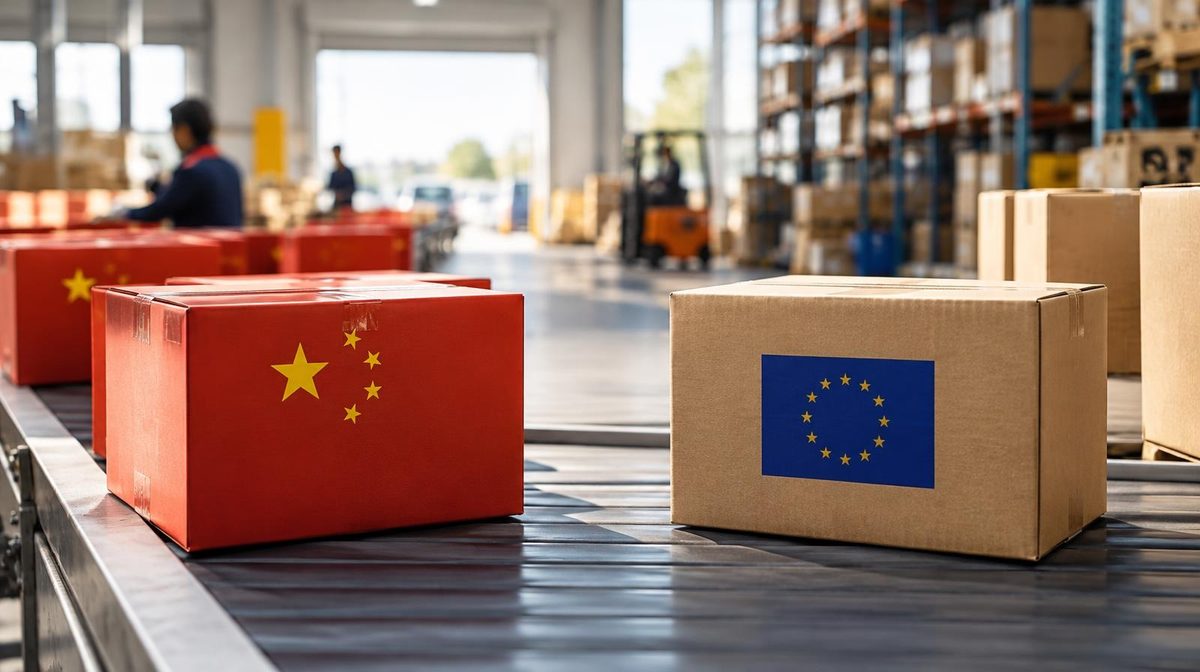
In March 2026, we analyzed 119,534 active sellers on Amazon.de and mapped each one to their country of origin. The breakdown:
- China:68,518 sellers — 57.3% of the total
- Germany:27,272 sellers — 22.8%
- United Kingdom:5,337 sellers — 4.5%
- Italy:1,948 sellers — 1.6%
- France:1,883 sellers — 1.6%
- Hong Kong:1,817 sellers — 1.5%
- Others:12,759 sellers — 10.7%
Let that sink in: Chinese sellers outnumber German sellers on Germany's own Amazon marketplace by more than 2.5 to 1. If you include Hong Kong-based sellers (many of which operate as extensions of mainland Chinese supply chains), the combined share exceeds 58%.
How to Read These Numbers
Our count measures sellers, not sales. A seller with a handful of offers counts the same as a large brand, so the 57.3% describes who is on the marketplace, not who takes most of the revenue. It also covers all active sellers, not only the biggest ones.
Older studies by Marketplace Pulse used a different lens: the top 10,000 sellers in each European marketplace, grouped by the business address that EU law requires sellers to disclose (Marketplace Pulse, 2019). Both views are useful, but their numbers can't be compared one to one.
Is Amazon in Germany Reducing Its Chinese Sellers?
Short answer: there is no public evidence of it. We found no Amazon announcement, policy or dataset showing that Amazon is reducing Chinese sellers or resellers on Amazon.de. The seller-origin data we could find points the other way over the long run:
| Published | Source | What was measured | China-based share |
|---|---|---|---|
| April 2017 | Marketplace Pulse | Active sellers, average of Amazon UK, DE, FR, IT and ES | 25% |
| June 2018 | Marketplace Pulse | Top sellers on Amazon.de, change over two years | 11% → 25% |
| May 2019 | Marketplace Pulse | Top sellers on Amazon.de, change over one year | 26% → 28% |
| September 2020 | Marketplace Pulse | Share of seller feedback on Amazon.de (a modeled proxy for sales) | 28% |
| March 2026 | Daniks.AI (this study) | All active sellers on Amazon.de | 57.3% |
These are different measures, so don't read them as a single trend line. But none of them shows a lasting decline. On Amazon.com, Marketplace Pulse reported that China-based sellers made up more than 50% of top sellers in 2024 (January 2025), so the direction is the same outside Europe.
The Dips in 2020 and 2021
The share has fallen before, briefly. Across the US, UK, German and Japanese marketplaces, Marketplace Pulse measured the share of top sellers based in China at 40% at the start of 2021 and 38% in September 2021 (Marketplace Pulse). It linked the dip to pandemic disruption and to Amazon's suspension of hundreds of established Chinese sellers that spring, and said the suspensions did not reflect a structural change in how Amazon regulates the marketplace.
Those suspensions were about reviews, not nationality. Amazon confirmed it had banned over 600 Chinese brands, spread across 3,000 seller accounts, for review fraud (Engadget, September 2021). Cindy Tai, Amazon's vice president for Asia Global Selling, said at the time that Amazon deals with violations without discrimination, regardless of a seller's size or home country (Caixin).
What Amazon Has Actually Done in Germany
- 2019, VAT: sellers shipping to or from Germany, or using FBA, had to upload a German tax certificate by 1 October 2019, because German tax authorities would otherwise hold Amazon responsible for unpaid VAT. ChannelX reported that several Chinese competitors disappeared from Amazon.de afterwards, though without figures (ChannelX)
- 2021, reviews: the review-fraud suspensions described above
- 2025, Haul: in June 2025 Amazon launched Haul in Germany, a low-price section in its app with products sold by Amazon itself and shipped directly to customers from its logistics centre in China (FashionUnited). That is not a company backing away from Chinese supply
The pattern is consistent: Amazon removes sellers who break rules, and the list of rules a seller must meet on Amazon.de has grown a lot since 2019. That filters out non-compliant sellers from any country. It does not reduce Chinese sellers as a group.
What Changed for Sellers on Amazon.de, 2019–2026
These are the rules that now decide who can sell in Germany. Most apply to every seller. Some cost a factory-direct seller in China more than a German brand, which already has an EU address and German registrations.
| Rule | Applies since | What it means on Amazon.de | Who feels it most |
|---|---|---|---|
| German VAT certificate | 1 Oct 2019 | Tax certificate required to sell from or into Germany or via FBA | Sellers without German VAT registration |
| EU VAT e-commerce package | 1 Jul 2021 | €22 import VAT exemption ended; IOSS for consignments up to €150; marketplace liable for VAT on non-EU sellers' sales | Non-EU sellers |
| Packaging law (VerpackG, LUCID) | 1 Jul 2022 | Marketplace may only list goods from LUCID-registered sellers; violations mean a sales ban | Everyone selling packaged goods in Germany |
| Electrical goods (ElektroG, WEEE) | Amazon deadline 5 Jun 2023; legal check 1 Jul 2023 | Electrical and electronic offers without a valid WEEE number are blocked | Electronics sellers, including resellers |
| EU product safety (GPSR) | 13 Dec 2024 | EU-based responsible person for non-food products; details on product and listing | Non-EU sellers without an EU entity |
| EU €3 customs duty on small parcels | 1 Jul 2026 to 1 Jul 2028 | €3 per item category in parcels under €150 sent directly to consumers | Sellers who ship each order from outside the EU |
| FBM on-time delivery | 1 Sep 2026 | Merchant-fulfilled sellers need an On-Time Delivery Rate of at least 90% | Sellers shipping their own orders, especially from abroad |
EU Product Safety (GPSR): An EU Responsible Person Since 13 December 2024
The General Product Safety Regulation (EU) 2023/988 has applied since 13 December 2024. It requires a person responsible for products sold online and offline, whatever the product's origin, and obliges online marketplaces to act within two working days when a market surveillance authority orders them to deal with an unsafe product listing (European Parliament summary).
Amazon told sellers that a Responsible Person established within the EU is mandatory for non-food products, that manufacturer and responsible person details must be visible on both the product and the listing, and that non-compliant listings risk removal (Amazon seller announcement). A seller in China with no EU entity has to contract an EU representative. A European brand is usually the responsible person already.
Packaging (VerpackG/LUCID) and Electrical Goods (ElektroG/WEEE)
Since 1 July 2022, every business placing packaged goods on the German market must be registered in the LUCID packaging register. Online marketplaces may only let sellers offer goods if they are registered and participate in a packaging scheme, they are obliged to check this, and violations mean a sales ban (Zentrale Stelle Verpackungsregister).
For electrical and electronic equipment, Amazon asked sellers to enter a German WEEE registration number by 5 June 2023 and said it would block offers without one; the legal duty for marketplaces to check took effect on 1 July 2023. Resellers who aren't the manufacturer must enter the manufacturer's number (IT-Recht Kanzlei).
VAT: The EU E-commerce Package and IOSS
Since 1 July 2021, goods worth less than €22 imported into the EU are no longer exempt from VAT, and non-EU sellers can use the Import One-Stop Shop (IOSS) for consignments up to €150 (Grant Thornton). Marketplaces became liable for the VAT in two cases: imports under €150 sold through them, and sales by sellers not established in the EU (Marosa VAT). Together with the 2019 German certificate rule, this makes it much harder to undercut on price by not charging VAT.
The New €3 Customs Duty on Small Parcels (From 1 July 2026)
On 11 February 2026, EU member states gave final approval to abolish customs duty relief for parcels valued under €150 (Council of the EU). As an interim measure, a flat €3 duty applies to each item category, by tariff sub-heading, in small parcels under €150 sent directly to consumers in the EU, from 1 July 2026 to 1 July 2028. Full tariffs follow once the EU customs data hub is running, currently expected in 2028. The Council's own example: a parcel with one silk blouse and two wool blouses contains two categories, so €6 is due.
The Council justified the change with unfair competition for EU sellers and said 4.6 billion small parcels entered the EU in 2024, with 91% of small shipments coming from China. The Council noted that this duty is separate from a proposed handling fee discussed as part of the wider EU customs reform.
What it means on Amazon.de: the duty hits sellers who ship each order from outside the EU. Inventory imported in bulk into Amazon's German warehouses is not a small consumer parcel, so most FBA sellers, Chinese or European, won't see this duty on their Amazon.de orders. It narrows the gap with direct-from-China shipping far more than with Chinese FBA sellers.
Stricter Delivery Standards for Merchant-Fulfilled Orders (From 1 September 2026)
Amazon raised the bar for Fulfilled by Merchant sellers in Germany and the UK: from 1 September 2026, they must keep an On-Time Delivery Rate of at least 90% or risk having listings deactivated, and accounts still on a default two-day handling time were switched to one day from 15 July (ChannelEngine, July 2026). Sellers shipping FBM orders from overseas feel this most.
Where Are Chinese Amazon Sellers Based?
Our Amazon.de dataset is mapped by country, so we don't publish a city ranking. The best public city-level data covers Amazon worldwide, not Amazon.de specifically, and it is several years old. Marketplace Pulse analyzed more than 250,000 Chinese sellers across Amazon's marketplaces (September 2019):
| City | Share of Chinese sellers | Province | Share of Chinese sellers |
|---|---|---|---|
| Shenzhen | 31.8% | Guangdong | 40.3% |
| Guangzhou | 5.1% | Shanxi | 9.6% |
| Taiyuan | 3.2% | Zhejiang | 6.8% |
| Lvliang | 2.3% | Fujian | 6.2% |
| Yiwu | 2.2% |
More recently, SmartScout counted over 102,000 Amazon sellers in Shenzhen and named Guangzhou, Putian and Dongguan as other Chinese seller hubs (SmartScout). Neither source gives figures for cities such as Jiaxing, Qingdao, Dalian, Nanjing, Wuxi, Nantong, Foshan or Tianjin, so we don't either.
Saw a Seller Address in China? How to Check a Seller on Amazon.de
Many people search a city name after spotting it on a seller page. Under Article 30 of the EU Digital Services Act, marketplaces must collect each trader's name, address, contact details, trade register details and a self-certification that it only offers products that comply with EU law, and must show buyers the contact, registration and self-certification details (CCPC, Irish consumer regulator). On Amazon.de, click the seller name next to "Sold by" to see them.
An address in Jiaxing, Qingdao or Foshan tells you where the company is registered. It says nothing about product quality on its own. Check these instead:
- Who ships it: an offer that dispatches from Amazon comes from Amazon's fulfilment network; a seller shipping from abroad takes longer
- The responsible person and manufacturer: GPSR details should appear on the listing
- Feedback and reviews: the seller's rating and the most recent reviews
- Returns: where returns go and who pays for them
Why Chinese Sellers Keep Growing on Amazon.de
This isn't a temporary blip. Cross-border selling from China into European marketplaces has been growing steadily for years, powered by a few structural advantages:
- Manufacturing proximity. Most consumer goods originate in Chinese factories. Selling direct-to-consumer on Amazon removes middlemen and leaves more room on price.
- Aggregator infrastructure. A mature ecosystem of logistics providers, listing optimization agencies and PPC tools exists specifically to help Chinese sellers scale internationally.
- Amazon's own incentives. More sellers means more selection, more competition and lower prices. Amazon benefits from this dynamic and runs a global selling program to recruit sellers abroad.
- Fulfilment by Amazon. Chinese sellers adopted FBA early: in Marketplace Pulse's 2017 data on Europe, 71% of Chinese sellers used FBA against a 47% average for all European sellers (Marketplace Pulse). Don't assume your Chinese competitors ship slowly.
For European sellers, this means the competitive landscape has changed fundamentally. You are no longer primarily competing with other local businesses. You're competing with a large, well-resourced cohort of sellers with structural cost advantages. For the wider picture across Amazon's European stores, see our Amazon PPC guide for European sellers.
How European Sellers Compete on Amazon.de
The temptation is to panic, or to try to compete on price. Neither is a strategy. Here's what actually works.
1. Stop Competing on Price
This is the number one mistake we see European sellers make when they realize the competitive pressure they're facing. Chinese sellers can often undercut you because their cost of goods is lower at the source. Trying to match them in a race to the bottom erodes your margins and rarely wins the Buy Box long-term.
Key insight: Competing on price with sellers who manufacture the product themselves is a losing game. Compete on everything else instead.
A worked example (illustrative numbers). You sell a product at €29.99. After 19% German VAT, your landed cost and Amazon's fees, you keep €9.00 per unit before advertising. A lookalike from a China-based seller appears at €22.99, and you sell about 1,000 units a month.
| Option A: match €22.99 | Option B: keep €29.99, buy the click | |
|---|---|---|
| Profit per organic sale | About €3–4 (the €7.00 cut is €5.88 net of VAT; your referral fee falls slightly) | €9.00 |
| Ad cost per ad-driven order | Not modeled | €0.80 CPC ÷ 12% conversion rate = €6.67, an ACoS of 22.2% |
| Profit per ad-driven sale | €3–4 minus any ad cost | €9.00 − €6.67 = €2.33 |
| Monthly profit, 1,000 orders (300 from ads) | About €3,000–4,000, before any ad spend | 700 × €9.00 + 300 × €2.33 = about €7,000, after ad spend |
A price cut costs you margin on every unit, including the sales you would have made anyway. Ad spend only costs you on the orders it brings in. The catch: Option B only works while your conversion rate holds. Your break-even ACoS here is €9.00 ÷ €29.99 = 30.0%. If the price gap pushes your conversion rate down to 8%, each ad order costs €10.00, an ACoS of 33.3%, and you lose money on ad-driven sales. At that point fix the offer (bundle, differentiate, add reviews), not the bid. Run your own numbers with our free Amazon ACoS calculator.
2. Defend Your Branded Search Terms
When shoppers search for your brand, they have already chosen you. That is exactly where cheaper lookalikes buy ad space to intercept them. A basic defense:
- Run Sponsored Products on your brand terms in exact match, and Sponsored Brands on top if you are brand-registered
- Target your own ASINs with product targeting, so the ad slots on your detail pages show your other products instead of a competitor's
- Add your brand terms as negatives in non-brand campaigns, so brand and non-brand performance stay separate
- Watch CPC on brand terms: a sudden jump usually means a competitor has started bidding on your name
Our brand defense campaigns guide covers the setup in detail.
3. Use Product Targeting Against Cheaper Listings
Product targeting puts your ad on competitors' detail pages and in shopping results. Amazon lets you refine product and category targets by brand, star reviews, price and Prime shipping eligibility (Amazon Ads). For a European seller, the best targets are listings where your offer is visibly better: lower-rated products, products without Prime delivery, or products in your price band where your reviews are stronger.
Judge each target on data, not hunches. Amazon's targeting guide recommends evaluating a target after at least 20 clicks. Keep the ASINs that convert, raise bids on them, and add the ones that keep taking clicks without orders as negative product targets. See our guides to ASIN targeting and competitor analysis.
4. Win on Delivery Speed
Fast shipping, hassle-free returns and local inventory aren't just nice-to-haves; they're competitive moats. German consumers expect fast, reliable delivery. Amazon says orders from its Haul section in Germany, shipped from China, should arrive within two weeks. A Prime offer from German stock competes on a different level.
- Use FBA, Pan-EU or multi-country FBA to place inventory close to customers
- Maintain buffer stock to avoid stockouts during demand spikes
- Offer Prime-eligible shipping wherever possible; it is a strong conversion driver
- If you ship FBM, keep your On-Time Delivery Rate well above the 90% minimum that applies in Germany from 1 September 2026
- Make returns frictionless: it builds repeat purchases and positive reviews
Our FBA vs FBM guide helps you decide which model fits each product.
5. Make Trust, Language and Compliance Visible
European sellers have built-in advantages that cross-border sellers have to buy or build:
- Native-language listings and customer support. German buyers notice (and prefer) listings written by native speakers, especially for complex or high-consideration products.
- EU compliance, shown on the listing. GPSR responsible person and manufacturer details, CE marking where it applies, WEEE and LUCID registration are now required by law or checked by Amazon. A named EU contact and complete safety information tell buyers who stands behind the product.
- Brand story and authenticity. "Made in Germany" or "Designed in Europe" still carries weight. Invest in A+ Content, Brand Stores and storytelling that communicates your origin and values.
6. Tighten Your PPC Basics
Advertising is where a well-run European seller can outperform a competitor with lower costs. PPC success isn't about who spends the most. It's about who spends where their offer converts best:
Smart bid management — Adjust bids based on conversion rates and placement performance. Amazon lets you raise bids by up to 900% for top of search, rest of search and product pages (Amazon Ads), so put the money where your listing wins.
Tight keyword targeting — Focus spend on high-intent, high-converting German search terms rather than broad, expensive head terms where you're competing against everyone.
Disciplined negative keywords — Search terms with 20+ clicks and no orders are the usual leak. Add them as negative exact or phrase match and let them run for two weeks before changing strategy again, as Amazon recommends. Our negative keywords guide covers the process.
Campaign structure — Separate brand, exact, research and product-targeting campaigns so you can set budgets and targets where they generate returns.
You don't need to outspend a competitor with lower costs. You need to stop paying for clicks that don't convert and win the ones where your offer is stronger, every day. That routine work is what PPC automation is for: Daniks.AI, for example, works from a target ACoS you set per marketplace and runs bids, budgets, keyword harvesting and negatives 24/7 in its own campaigns.
The Bigger Picture: Compete on Precision, Not Price
The data is clear: Chinese sellers dominate Amazon.de by volume, and nothing suggests Amazon is changing that. But volume doesn't automatically translate to visibility, trust or profitability. European sellers who lean into their natural advantages (language, compliance, brand, logistics) and pair them with sharp, data-driven advertising can absolutely thrive.
The sellers who lose are the ones who either ignore the competitive shift or try to fight it on the wrong terms. Don't compete on price. Compete on precision.
The bottom line: In a marketplace where 57% of your competitors have a structural cost advantage, your edge comes from operating smarter — not cheaper. Invest in your brand, your compliance, your listings, and above all, your advertising strategy.
Frequently Asked Questions
How Many Amazon.de Sellers Are From China?
In our March 2026 analysis of 119,534 active sellers on Amazon.de, 68,518 (57.3%) were based in China, against 27,272 (22.8%) in Germany. Adding Hong Kong takes the combined share above 58%. Note that this counts sellers, not sales.
Is Amazon Reducing Chinese Sellers in Germany?
We found no evidence of it. Seller-origin data from Marketplace Pulse and our own study points up over the long run, with short dips in 2020 and 2021. Amazon removes sellers who break rules, such as the review-fraud bans of 2021, and the compliance rules for Amazon.de keep growing, but they apply to every seller regardless of origin. In June 2025 Amazon even launched Haul in Germany, shipping directly from China.
Do Chinese Sellers on Amazon.de Need an EU Responsible Person?
Yes, for non-food products. Since the GPSR began to apply on 13 December 2024, Amazon requires a Responsible Person established in the EU, with their details and the manufacturer's shown on the product and the listing. Non-compliant listings risk removal.
Does the EU's €3 Parcel Duty Affect Chinese Sellers on Amazon.de?
Only those who ship each order from outside the EU. From 1 July 2026 to 1 July 2028, the EU charges €3 per item category in parcels under €150 sent directly to consumers. Sellers whose stock is already in Amazon's German warehouses import it in bulk, so the duty doesn't apply to their individual Amazon.de orders.
How Can I Check Where an Amazon.de Seller Is Based?
Click the seller name next to "Sold by" on the product page. EU rules require marketplaces to show the trader's name, address, contact and trade register details. A Chinese address only tells you where the company is registered; check who ships the item, the GPSR responsible person, the seller's feedback and the return terms.
Can European Sellers Still Compete With Chinese Sellers on Amazon?
Yes, but not on price. Defend your brand terms, use product targeting against weaker listings, sell from German stock with Prime delivery, make your compliance visible and keep your PPC disciplined. The worked example above shows why holding your price and buying the click can earn more than matching a lower price.
Ready to turn your PPC into a competitive advantage?
Try Daniks.AI and see how automated, intelligent PPC management can help you outperform in a crowded marketplace.
Start Your Free Trial