
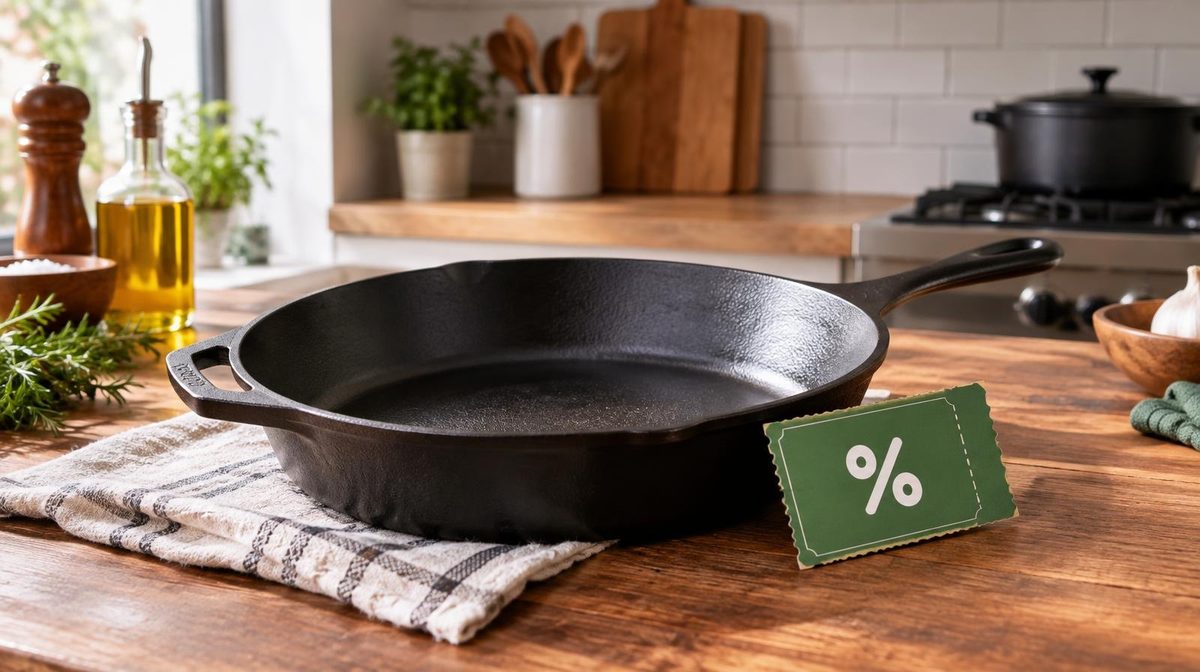
Marcus sells cast iron cookware. Last March he clipped a 20% coupon onto his best-selling $79 skillet because a competitor had just launched at $69 and he was watching his session share slide.
The coupon worked. Units went from 14 a day to 39. His Best Sellers Rank climbed four hundred places. He posted a screenshot in a seller group.
Then his accountant ran the month. The 20% discount cost him $15.80 a unit. The redemption fee cost another $0.60. His referral fee dropped a little because the sale price dropped, but not nearly enough to matter. On 1,170 promoted units he had given away roughly $19,200 in margin to generate about $6,800 in additional gross profit. He had run a very successful promotion straight into a loss.
The part that stung more: his ad spend didn't change, but his ads got dramatically cheaper per order, and he never adjusted a single bid to take advantage of it.
That is the whole problem with Amazon coupons for sellers. They are the easiest promotion to turn on, the hardest to price correctly, and almost nobody connects them back to the advertising account, which is where most of the money is won or lost.
Here is the full 2026 promotion stack, what each type actually costs, the conversion-rate math that decides whether it pays, and how to sequence promotions against your PPC calendar.
Why Promotions Are a PPC Lever, Not a Marketing Afterthought
Most sellers file promotions under "pricing" and advertising under "PPC," and the two never talk to each other. That is backwards, because a promotion changes your advertising economics the moment it goes live.
Run the math. Say you sell at $40, your conversion rate on ad traffic is 9%, and your average CPC is $1.10.
- Cost per order: $1.10 ÷ 0.09 = $12.22
- ACoS: $12.22 ÷ $40 = 30.6%
Now clip a 15% coupon. Your price drops to $34, and your conversion rate rises to 13% — a realistic lift for a visible discount badge on a mid-priced consumable.
- Cost per order: $1.10 ÷ 0.13 = $8.46
- ACoS: $8.46 ÷ $34 = 24.9%
Your ACoS improved by nearly six points and you didn't touch a bid. That is the good news. The bad news is that you also gave up $6 of revenue per unit plus a redemption fee, so your contribution margin per order may well be worse even though the dashboard metric looks better.
This is the trap. ACoS falls during promotions almost automatically, which makes sellers feel like the promotion is working when the P&L says otherwise. If you want the real picture, you have to hold the promotion cost inside the same equation, which is exactly what break-even ACoS is for, and why the complete ACoS guide matters more during a promotion than outside one.
The upside is genuinely large when you do it deliberately. A higher conversion rate means every click is worth more, which means you can profitably bid higher, which means you win placements you normally lose. A promotion is a temporary permission slip to be aggressive. Most sellers never cash it in.
The 2026 Amazon Promotion Stack
Amazon gives sellers six meaningfully different promotion mechanisms. They are not interchangeable.
| Promotion type | Seller cost | Search badge | Brand Registry | Best for |
|---|---|---|---|---|
| Coupon | Discount + per-redemption fee | Yes, green discount badge | No | Steady CVR lift, launches |
| Lightning Deal | Discount + flat deal fee | Yes, "Limited time deal" | No | Short spikes, event days |
| Best Deal / 7-day deal | Discount + flat deal fee | Yes, "Deal" badge | Usually | Sustained multi-day velocity |
| Prime Exclusive Discount | Discount only, no fee | Yes, strikethrough price | Yes | Prime Day, BFCM, everyday value |
| Subscribe & Save | Ongoing % discount | No badge, S&S box on listing | No | Consumables, repeat revenue |
| Brand Tailored Promotion | Discount only, no fee | No, private code | Yes | Repeat buyers, cart abandoners |
The two columns that matter most are the badge column and the fee column. A badge buys you click-through rate in search results, which affects your ads too, because a Sponsored Products listing with a discount badge gets clicked more than the same listing without one. No badge means the promotion only converts people who already reached your product page.
Coupons
The workhorse. You set a percentage or dollar discount, fund a budget, and Amazon shows a clippable green badge in search results and on your listing.
The economics in 2026, US marketplace:
- Discount range: 5% to 80% off
- Redemption fee: $0.60 per clipped-and-purchased unit
- Minimum budget: $100, reserved up front
- Duration: up to 90 days per campaign
- Price rule: the discounted price generally must sit at or below the lowest price the item sold for in the previous 30 days
Amazon adjusts this fee schedule periodically, so pull the current numbers from the Amazon selling fees page before you model anything at scale.
The redemption fee is the piece sellers forget. At a $12 price point, $0.60 is 5% of revenue on top of your discount. A "10% coupon" on a $12 item is really a 15% promotion. At a $79 price point, that same fee is under 1% and effectively noise.
Pro Tip: Below roughly $20, treat the redemption fee as part of the discount. Above $50, ignore it.
The other thing about coupons: budget burns fast when they work. Marcus reserved $2,000 and it evaporated in nine days. When a coupon budget runs dry the badge disappears mid-campaign, your conversion rate drops back, and your bids — which you probably raised — are suddenly overpaying for traffic that no longer converts. Set a calendar reminder for the day your budget is projected to run out.
Lightning Deals and Best Deals
Deals are the high-intensity option. A Lightning Deal runs for a few hours with a limited unit count and a progress bar. A Best Deal (often a 7-day deal) runs for days at a lower discount.
Both charge a flat fee per deal, and the fee is dynamic: cheap in a slow February week, expensive during Prime Day and Black Friday, when demand for deal slots vastly exceeds supply. Event-week fees can be several times the off-peak rate.
Deals are worth running when at least one of these is true:
- You need a ranking spike inside a specific window — a launch, a category event, a competitor's launch you want to blunt.
- You have inventory you must move before a long-term storage fee date.
- You are building velocity ahead of an event and want the algorithm to see momentum before the traffic arrives.
They are a bad choice when you just want ongoing sales. A deal is a spike, and spikes decay. The sales rank guide covers why velocity decays the way it does. The short version: BSR responds to recent sales far more than to total sales, so the day after your deal ends you start sliding.
Pro Tip: Never run a deal without pre-scaling your ad budget for the same window. A deal drives a traffic surge, and Sponsored Products campaigns that hit their daily cap by 11 a.m. hand the rest of the day's demand to whoever is still bidding.
Prime Exclusive Discounts
Prime Exclusive Discounts (PEDs) are the most underrated item on this list, because they carry no per-unit fee at all. You need Brand Registry, a minimum discount, and a price at or below the recent low. In exchange you get a strikethrough reference price in search results, which is visually stronger than a coupon badge on most listings.
PEDs are also the required mechanism for participating in Prime Day and Prime Big Deal Days pricing. If you plan to be visible during those events, this is the tool. Our Prime Day PPC strategy guide covers the timing side in detail; the promotion side comes down to submitting early enough to clear review and holding enough inventory to survive the day.
Subscribe & Save
For consumables, this is the only promotion here that compounds. You fund a 5% or 10% discount, and in return you get a customer who reorders automatically without another ad click.
The math is different from every other promotion on this list, because you have to think in lifetime value. A 10% discount on a $30 consumable costs $3 per order. If the average subscriber stays for five orders, you paid $15 to acquire $150 of revenue that required exactly one ad click. Compare that to $12 of ad cost per order, five times over, and Subscribe & Save is the cheapest customer acquisition on Amazon for the right product.
If you sell anything people re-buy on a schedule, this should be on before anything else.
Brand Tailored Promotions
Free, brand-registered, and almost nobody uses them properly. You pick an audience Amazon has already segmented for you — repeat customers, high-spend customers, cart abandoners, brand followers, recent customers — and send that group a private discount code.
There is no fee and no public badge, which means no reference-price damage and no discount visible to price-shoppers. You are discounting only to people who already showed intent.
Cart abandoners are the obvious first target. Brand followers are the sleeper: they opted in, they see your posts, and a code aimed at them converts far above a blanket coupon.
The Real Cost of a Promotion: A Worked Example
Take a $34.99 product with a $12.40 landed cost and a 15% referral fee.
| Line item | No promotion | 15% coupon |
|---|---|---|
| Revenue | $34.99 | $29.74 |
| Referral fee (15%) | −$5.25 | −$4.46 |
| FBA fee | −$5.90 | −$5.90 |
| COGS | −$12.40 | −$12.40 |
| Redemption fee | — | −$0.60 |
| Contribution | $11.44 (32.7%) | $6.38 (21.5%) |
You gave up $5.06 per unit, 44% of your contribution margin, for a 15% discount. That is the number nobody calculates before clipping the coupon, and it is why "15% off" is not a small promotion. It is close to half your profit per unit.
Now add advertising. Suppose 40% of your orders come from ads at a 30% ACoS baseline. Without the coupon, ad cost on those orders is $10.50 each, so blended contribution across all orders is roughly $7.24. With the coupon, conversion improves and ad cost per order falls to about $7.80 — but you also gave up $5.06 of margin on every order, including the organic ones. Blended contribution lands around $3.26.
The promotion cut your per-unit profit by more than half. It only pays if the volume more than doubles, or if you are buying something other than immediate profit: rank, reviews, a launch, inventory clearance.
Note: That last clause is the honest case for promotions. Most good promotions are not profitable in the month they run. They are profitable in the three months after, through better organic rank and lower ad costs. Judge them on that window, not on the promotion week.
Adjust Your Bids During a Promotion. This Is Where the Money Is.
Here is the step almost everyone skips. When your conversion rate rises, your maximum profitable bid rises with it. If you leave bids where they were, you simply pocket a lower ACoS and forfeit the volume you could have bought.
The formula: Max profitable bid = Contribution per unit × Conversion rate × Target ACoS fraction
Using the coupon example above, at a 13% conversion rate the bid you can justify during the promotion is meaningfully higher than the bid you could justify at 9% — often 25 to 40% higher on the same keywords.
So the promotion playbook has three moves, not one:
- Raise bids on your proven converters at the start of the promotion, and only those. Do not raise bids account-wide.
- Push Top of Search placement modifiers up, because the discount badge does the most work where the most eyes are. The placements guide explains how those modifiers stack.
- Drop everything back the day the promotion ends. This is the step that costs sellers real money.
The reversion is the dangerous part. Conversion rate falls the hour the badge disappears; your bids do not. Three days of overbidding against a normalized funnel can erase the entire gain from a two-week promotion.
Doing this by hand across a few hundred keywords, twice per promotion, on the right days, is not realistic for most sellers. This is precisely the kind of continuous recalculation that Daniks.AI runs automatically: bids follow the conversion rate as it moves, up during the promotion and back down after it, without anyone remembering to log in.
💡 Daniks.AI Advantage: Set your ACoS target once. When a coupon or deal lifts your conversion rate, bids rise to capture the extra volume; when the promotion ends and conversion normalizes, bids come back down the same day. No calendar reminders, no post-promotion overspend.
Choosing the Right Promotion by Objective
| Your goal | Use this | Avoid this |
|---|---|---|
| Launch a new ASIN | Coupon (15–20%) + aggressive PPC | Lightning Deals — you lack the review base to convert the traffic |
| Build velocity before Prime Day | Prime Exclusive Discount, submitted early | Coupons the week of — you'll burn budget against event CPCs |
| Clear aging inventory | Best Deal or a deep coupon | Subscribe & Save — you want it gone, not subscribed |
| Defend against a competitor's launch | Brand Tailored Promotion to repeat buyers | Public coupon — you'd discount to everyone to stop one rival |
| Grow repeat revenue | Subscribe & Save | Lightning Deals — attracts one-time deal hunters |
| Recover a slipping conversion rate | Fix the listing first | Any promotion — discounts mask listing problems |
That last row deserves emphasis. If your conversion rate is below category average, a coupon buys you a temporary patch over a permanent problem. Images, title, A+ content, and reviews move conversion permanently and cost nothing per unit. Work through conversion rate optimization and listing optimization before you start discounting. A listing fixed once beats a coupon funded forever.
Five Mistakes That Turn Promotions Into Losses
1. Stacking without checking the total. A Subscribe & Save discount plus a coupon plus a Prime Exclusive Discount can compound into a price you never intended to offer. Amazon does not stop you. Model the worst-case stack before you enable the second promotion.
2. Destroying your reference price. Run deep discounts continuously and Amazon's featured-offer logic — and your customers — recalibrate to the discounted price as normal. When you stop, you look expensive against your own history. Promotions should be events, not a permanent state.
3. Ignoring the 30-day low rule. Most promotion types require the discounted price to be at or below the lowest price of the previous 30 days. Sellers who discount constantly find themselves ineligible for the promotion they actually cared about, right before the event they were saving it for.
4. Running a promotion into a stockout. A deal that sells out on day one wastes the fee and hands the velocity to a competitor. Worse, going out of stock mid-promotion costs you the rank you just paid to gain.
5. Not tracking the after-window. The promotion week always looks like a success: volume up, ACoS down. The question is what your organic sessions and organic orders look like three weeks later. If they haven't moved, the promotion bought you nothing but a discount. Amazon's own advertising resources and your Brand Analytics reports both give you the organic side of that picture.
Frequently Asked Questions
Do Amazon coupons actually increase sales?
Yes, reliably. The green badge lifts both click-through rate in search results and conversion rate on the listing. Typical lifts run 20 to 50% on units for a 10 to 20% discount, though the effect is much stronger in price-sensitive categories than on premium or gift purchases. The question is never whether it moves units. It's whether the margin you gave up is smaller than the profit the extra units produced.
How much does an Amazon coupon cost the seller?
The discount plus a $0.60 redemption fee per unit sold with the coupon clipped, in the US marketplace. There is no charge for a coupon that shoppers see but don't redeem. You must fund a minimum budget of $100 up front, which Amazon reserves and draws against.
What's the minimum discount for an Amazon coupon?
5%, and the maximum is 80%. In practice, discounts below 10% generate weak lift because the badge promises more than the number delivers. Shoppers who click through and see "5% off" often bounce.
Are Lightning Deals worth the fee?
Only against a specific objective: a launch, an event, or an inventory deadline. As a standalone profit exercise they rarely clear the bar, because you pay a flat fee, a deep discount, and get a spike that decays within days. Judged as a rank-buying tool over a 30-day window, they often do pay.
Can I run a coupon and a Prime Exclusive Discount at the same time?
Technically yes in some configurations, but the discounts can compound. Check the final customer price in preview before you enable the second one, because the combined price is what shoppers get charged, not the larger of the two.
Should I raise my PPC bids during a promotion?
Yes, on keywords that already convert for you, and then lower them the day the promotion ends. Higher conversion supports a higher bid, but the support disappears the moment the badge does. The failure mode is remembering the first half and forgetting the second.
The Short Version
Promotions on Amazon are not a marketing add-on. They are a temporary change to your unit economics that flows directly into your advertising performance, and they only pay when you treat them that way.
Price the promotion properly: discount plus fees, against contribution margin, not against revenue. Pick the mechanism that matches the objective instead of defaulting to a coupon. Raise bids while the conversion rate is elevated, and put them back the day it isn't. Then judge the whole thing on the month after the promotion, not the week during it.
Marcus still runs coupons on that skillet. They're 10% now instead of 20%, they run in two-week bursts instead of continuously, and his bids move with them. Same tool, roughly a third of the margin cost, and his organic rank held.
Ready to automate your Amazon PPC?
Daniks.AI adjusts bids as your conversion rate moves — up during promotions, back down after — so you capture the volume without the post-promotion overspend.
Start Your Free 14-Day Trial14-day free trial · Cancel anytime